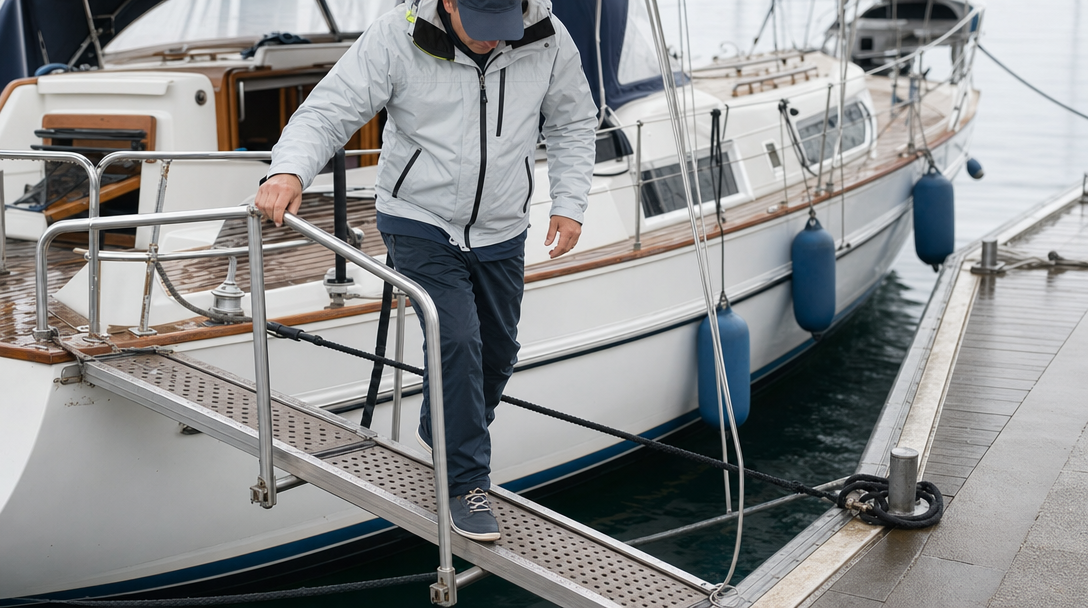
During mooring, a person descends the ladder, handles the line with one hand, and then finds themselves on a wet surface. Their attention is focused on the task at hand, and a simple climb up the ladder turns into a fall. Such a fall can occur even during routine work alongside the ship.
Yachting hazards arise not only during storms or serious incidents. Injuries on a yacht can occur while descending a gangway, handling a taut mooring line, walking barefoot, and preparing hot food. There's also a less obvious risk: ultraviolet radiation can be harmful even when it's cool, cloudy, and the sun barely shines. Let's look at how to change your routine to reduce these risks.
How to navigate ladders and decks more safely
An external ladder is especially dangerous when a person is simultaneously engaged in another task. While mooring, one end can be secured, one can begin descending, and lose focus on the support. Wet steps, a smooth deck, and the lack of a free hand for the handrail increase the risk of falling.
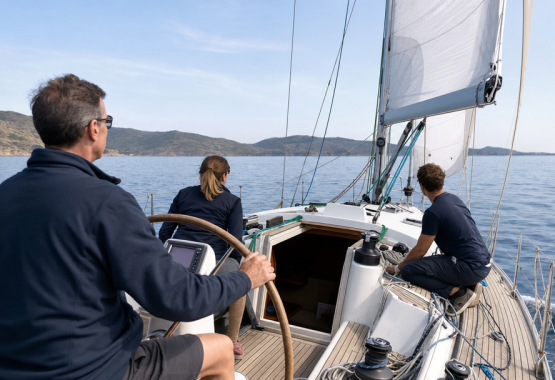
The staircase from the saloon to the cockpit requires special attention. Descending facing forward makes the body less stable. In this situation, it is recommended to turn with your back to the saloon or walk sideways, but in any case, hold on to the handrails and handles. The choice of position depends on the design of the staircase and the yacht's movement.
After swimming, the risk increases due to wet feet. While the external gangway may have a non-slip surface, the floors and decks inside the yacht may not, making the surface slippery. Before crossing, it's best to assess whether the footing is dry, focus on moving, and avoid descending while simultaneously working the mooring line.
Walking barefoot on deck is another common injury risk. Even at anchor, when it seems safe to walk carefully, it's easy to hit a toe on a protruding structure. Such impacts can lead to bruises and fractures, so closed-toe shoes are essential when walking on board. While they don't eliminate all risks, they do reduce the likelihood of a direct blow to the foot.
Why mooring lines are dangerous even during normal mooring
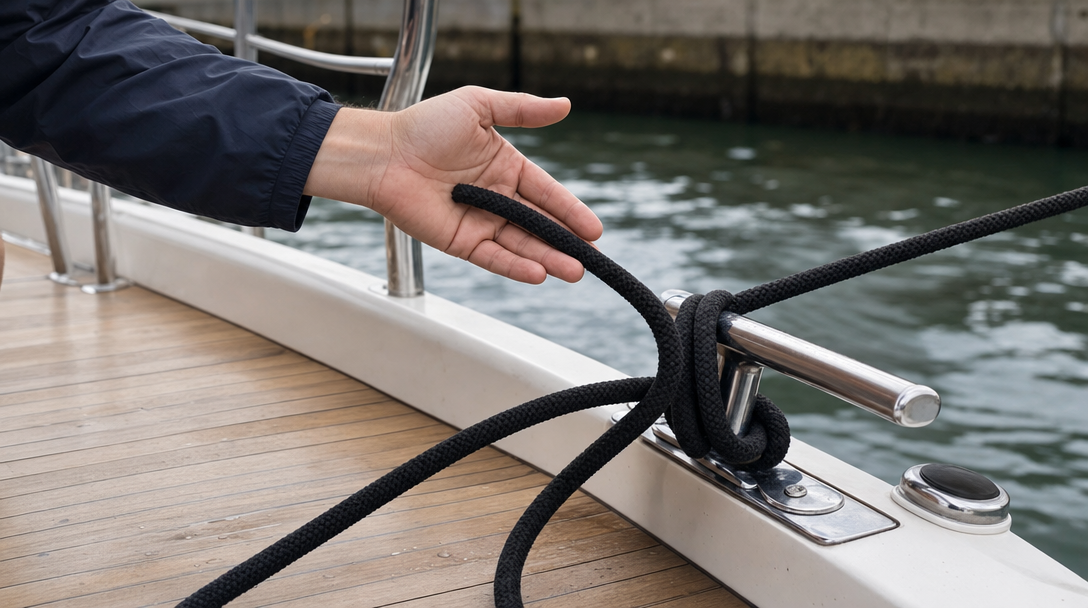
A mooring line is dangerous not only when the yacht is moving. Under its load, fingers can become caught under the mooring pin, or a hand or foot can become caught in the loop. When the yacht is moving, the loop can tighten, and the loaded line can jerk suddenly, for example, due to wind or a change in the system's tension.
- Determine the load zone. Before proceeding, check the location of the taut section, where the loop has formed, and which way the line might go. When moored, the entire system can become taut with an anchor and a guy line, causing a seemingly ordinary mooring line to become a source of sudden movement.
- Do not place your limbs in the path of the end. Fingers, hands, and feet should not be under the mooring line or inside the loop. It's especially dangerous to hold the line in such a way that the force of the pull falls on your hand or fingers.
- When etching, use an open palm. The end should be held with the palm of the hand, with the fingers extended outward. This technique allows for controlled movement without gripping the loaded area with the fingers.
The point of these actions is to see in advance the tension and the possible trajectory of the end's movement, and not to perceive the mooring line as an ordinary rope.
What happens in the galley when the yacht starts to rock?
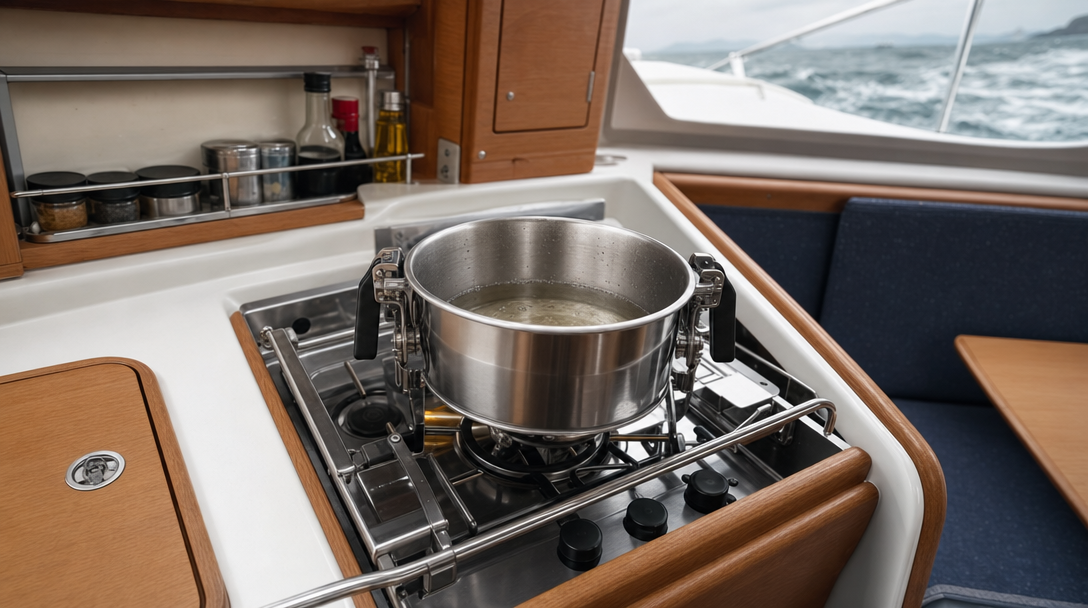
The yacht's stove is suspended and oscillates with the vessel's motion, compensating for the list. However, the suspension doesn't eliminate the risk entirely: a pot of boiling water remains a source of burns, especially when the yacht is hit by a passing wave.
The pot should never be filled more than halfway. It should also be secured with clamps to prevent the pot from shifting during normal sea motion. However, clamps don't provide absolute protection: a strong wave can splash boiling water even from a secured pot.
Therefore, safety in a yacht's galley depends not only on the stability of the utensils but also on the sea state. In severe sea conditions, preparing hot food can be dangerous or even impossible. If the water and utensils are no longer stable, do not continue cooking.
Why is ultraviolet radiation dangerous even under clouds?
A storm is immediately noticeable, but ultraviolet radiation acts silently. Infrared radiation feels like heat: it makes you feel hot and sweaty. UV radiation can be barely felt, so cool weather doesn't mean there's no effect.
On a yacht, UV rays don't just come from above. Water reflects some UV rays, and white decks and sails can reflect them additionally. Water is rated at up to 20% reflectivity, while white surfaces are rated at up to 80% reflectivity. These figures aren't universally applicable to every yacht and weather, but they help explain why shade, a bimini, or being on a catamaran don't offer complete protection.
A distinction is made between UVA and UVB. UVB is associated with reddening and subsequent peeling of the skin; some of these rays are blocked by clouds and glass. UVA passes through clouds and haze, does not necessarily cause pain, and is associated with effects on collagen and DNA, pigmentation, skin aging, and the risk of cancer. UVC, in this classification, does not reach the Earth's surface.
The UV index is checked in the weather forecast. A value above 3 is a reason to use sun protection, but at sea, reflection from water and white surfaces also affects the effect. Therefore, the forecast figure cannot be considered separately from the amount of time a person will spend on deck and whether there are any reflective surfaces nearby.
Clouds also create a false sense of security. They block some heat, making it cooler, but they don't provide a reliable "umbrella" against UV rays. Different cloud conditions transmit different amounts of radiation, so an overcast anchorage isn't a reason to forgo protection. Before going on deck, check the UV index, taking cloud cover and reflectivity into account, rather than relying solely on the sun's brightness and perceived heat.
How to pack UV protection on board
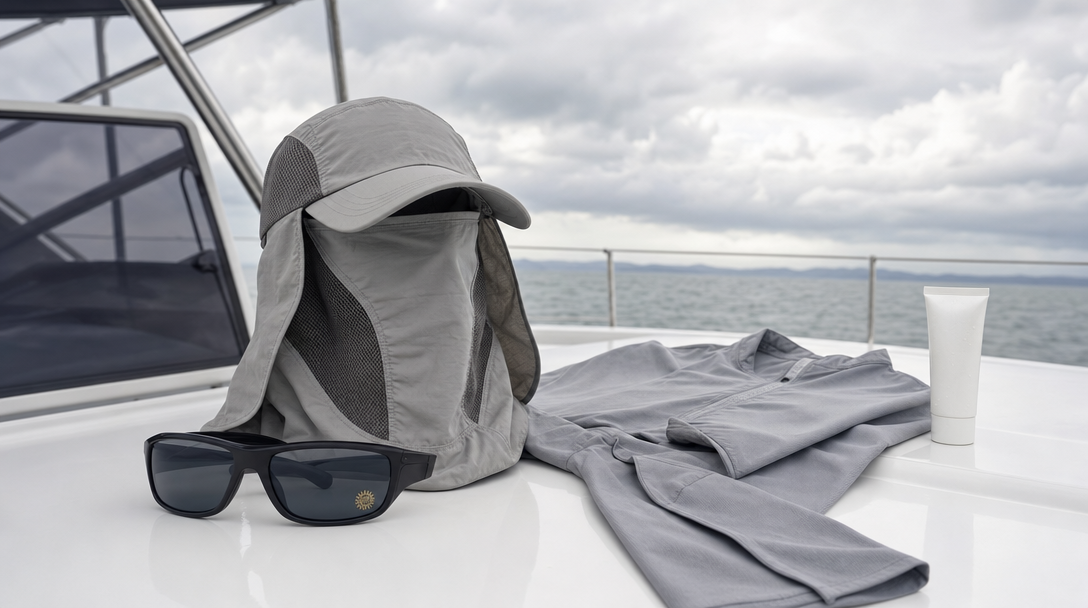
UV protection on a yacht requires a combination of several products. Sunscreen alone is not enough, especially if you spend long periods of time on the open deck.
- Closed clothing. Fabric serves as the basis of protection, although different materials transmit UV at different rates and can be stuffy.
- Headdress. A suitable option is one with neck and face protection and a chin strap to prevent it from falling off. The face and neck protection can be detachable.
- Zinc stick. It's used on the face. It doesn't absorb and acts as a reflective layer; however, it's difficult to wash off—so it's recommended to use oil, such as olive oil, for that purpose.
- Glasses. For yachting, choose sunglasses with UV 400 rating and polarization. They are also recommended for gray weather, when the sun's rays don't provide the usual bright sensation.
- Sunscreen. SPF 50 is mentioned, along with the label "Broad Spectrum," which indicates protection from both types of UV rays. Other designations include PA+, PA++, PA+++, and PA++++: more pluses indicate higher UVA protection.
Before going on deck, it's a good idea to check your clothing, hat, goggles, and sunscreen labels. These products cover different areas—skin, face, and eyes—so don't use any of them as a complete replacement for the others.
What to check before routine yacht operations
Yacht safety begins with a brief assessment of the situation before a routine action. Before sailing, check the support and surface moisture; before handling the line, check the tension and position of the loop; before cooking, check the volume of liquid, the pot's stability, and the pitching force. Before going on deck, consider the UV index and prepare protection even in cloudy weather.
To quickly check, ask yourself four questions:
- Is the surface dry and non-slip enough, and are your hands free to use the handrail?
- Are your fingers, hands or feet caught in the mooring line tension zone?
- The pot is no more than half full and will the galley withstand the current pitching?
- Are there any clothes, glasses marked UV 400 and a product with UVA and UVB protection?