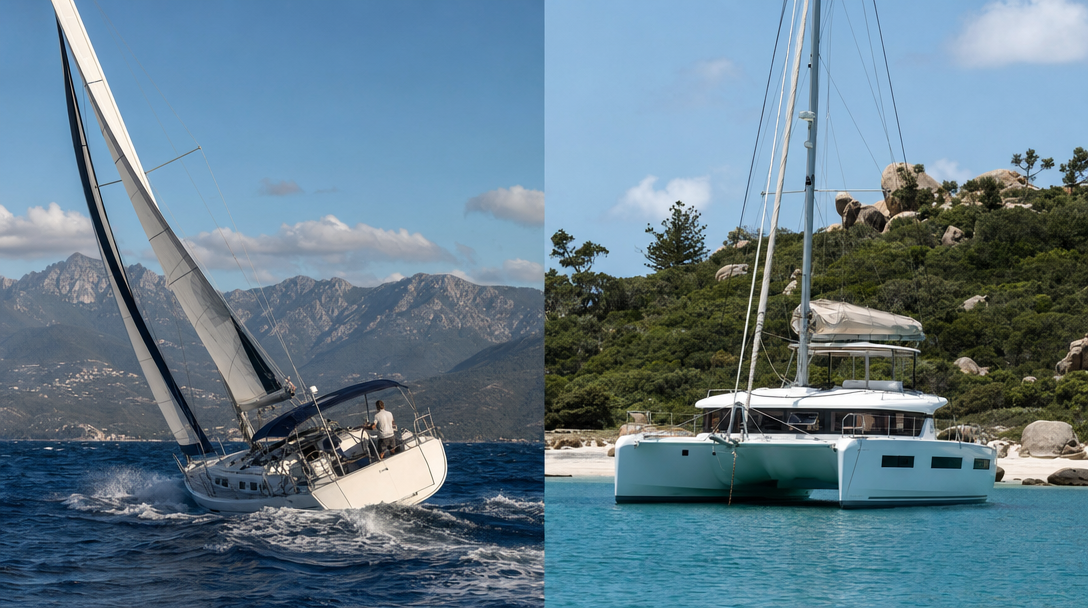
When choosing a boat, you try to narrow everything down to one factor: comfort or speed. On a monohull, you have to consider heel angle, rudder load, and windward movement, but in return, you get clear feedback. On a catamaran, you can walk on a flat deck, sleep without leaning, and easily moor with two engines, but you'll pay a different price on the high seas and when making payments at the marina.
The question "monohull or catamaran" is often reduced to a debate about tradition and modernity. But in reality, a single hull with a ballast keel and two narrow hulls with a bridge deck are different engineering solutions attempting to cope with the same elements. Architecture changes everything: water resistance, living space, draft, ownership budget, and storm scenarios. The choice isn't an absolute winner, but a set of compromises that suits your itinerary.
How hull architecture changes speed and stability on the water
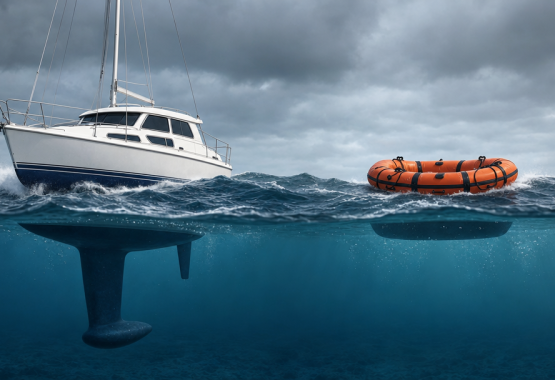
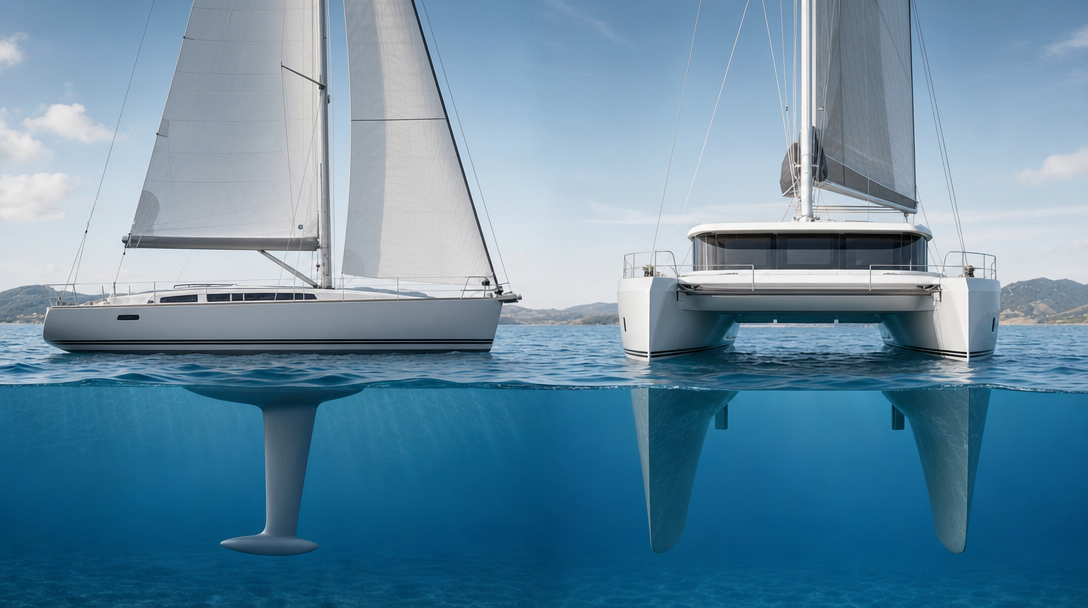
A monohull rests on a deep ballast keel: the low-lying weight creates a righting moment when tilted. A catamaran gains initial stability from the width and buoyancy of its two spaced hulls. It resists roll even at small angles, whereas a monohull allows for a significant tilt before tending to return to its normal position.
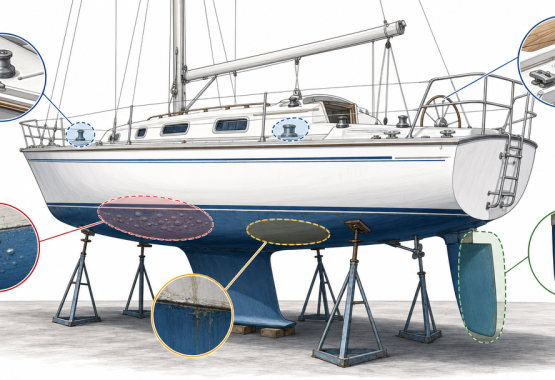
Judging a catamaran's speed against a monohull's is pointless. Both hulls have a larger wetted surface area, so at low speeds, in light winds, or when the bottom is fouled, water resistance increases. A thin layer of slime can seriously impair performance; in some cases, top speed drops by as much as 20%.
At high speeds, the physics of the process change. Narrow catamaran hulls generate smaller waves, achieving a gain in wave resistance. The wide hull of a monohull, on the other hand, expends increasing energy to overcome its own wave. In suitable conditions, a catamaran can sail approximately 20% faster, but actual performance depends on the course, sea conditions, load, and specific design.
When comparing speed characteristics, it's best to focus not on advertising promises, but on the actual sailing conditions: prevailing winds, actual courses, bottom cleanliness, and total weight on board.
What changes for the crew: the roll, the impact of the waves and the sensation of movement
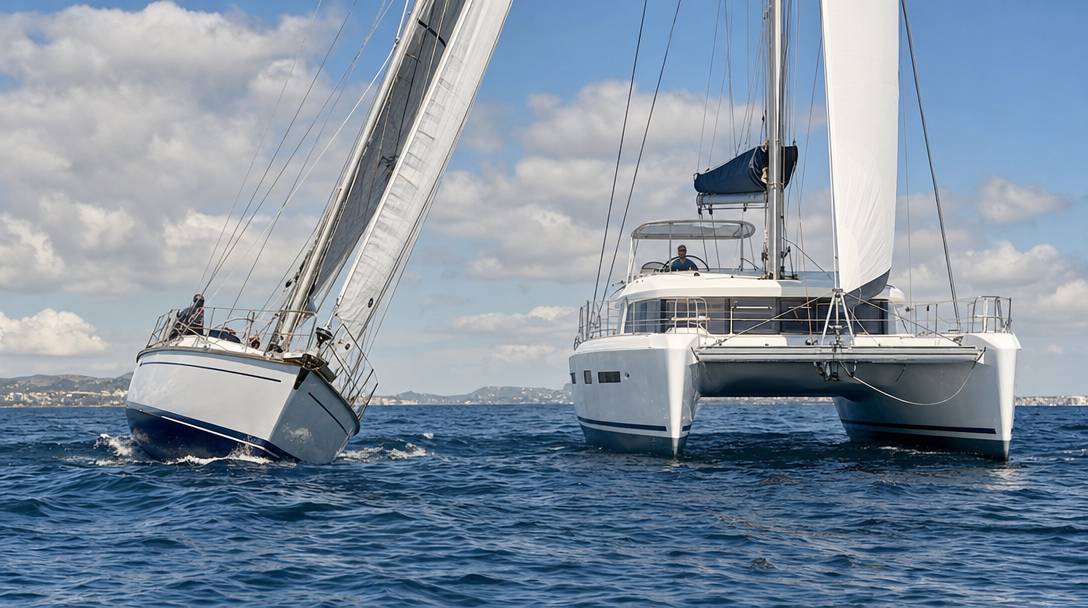
While the monohull heels at 20-30 degrees, the catamaran maintains a 5-10 degree tilt during daily operation. Moving around the deck is easier, items don't scatter around the cabin, and cooking and sleeping become significantly easier. For families or guests, such a stable platform is often the deciding factor.
However, less heel doesn't mean a smoother ride. A monohull yacht moves in a long, pendulum-like rhythm, letting the wave roll beneath it. A rigid catamaran tracks the water's slope more sharply, causing accelerations and rolling periods to feel shorter and more sudden.
The bridge deck is a particular risk area. In short or choppy seas, water is forced into the tunnel between the hulls. If the clearance is insufficient, strong impacts occur on the structure, leading to noise, fatigue, and sleep deprivation for the crew. A large saloon on the bridge deck attracts buyers, but manufacturers often increase its height precisely at the expense of this essential clearance above the water.
When deciding which option is best for life on the water, it's important to clearly distinguish between comfort at anchor and the smooth ride on the open sea. These are two distinct characteristics.
How boats behave on course, during maneuvers and in complex scenarios
Heading into the wind and following passages
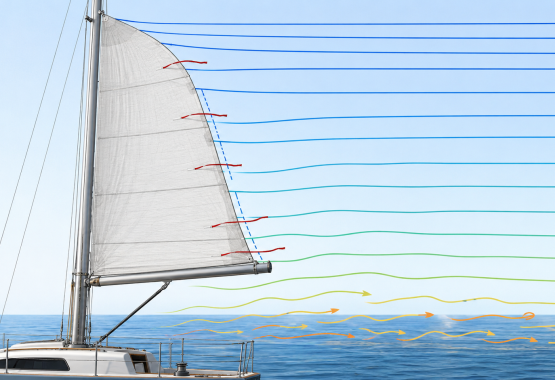
On close-quarters courses, a monohull has the advantage. The deep keel profile reduces lateral drift and allows the vessel to sail closer to the wind. A good monohull tacks at an angle of approximately 90–100 degrees to the apparent wind. Cruising catamarans, due to their shallow draft and the use of mini-keels, are forced to tack wider—approximately 110–120 degrees.
A catamaran can compensate for its unfavorable angle with speed, reaching its destination upwind in the same amount of time. Its potential is realized on a beam wind and other favorable downwind courses, where high speed shortens the passage time. However, when sailing directly downwind, due to the specifics of its rig, many multihulls require zigzagging, using the apparent wind, rather than a straight course.
Maneuvers and behavior during rollover
Under sail, a monohull feels more natural to the helmsman: the keel, inertia, and pressure on the rudder blade make tacking predictable. A catamaran, due to its sail-like hull and lightweight construction, can lose inertia and become tacked, especially when loaded. However, under engine power, it has a powerful advantage: two spaced propellers allow the platform to turn virtually on the spot.
Finding a suitable width for a catamaran in a marina is more difficult, but the mooring process itself turns from a struggle with inertia into precise control of the thrust of two engines.
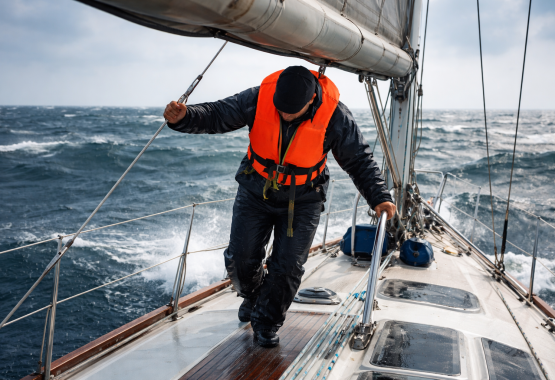
In a critical situation, boats behave differently. Thanks to ballast, a monohull can right itself after capsizing, although this won't prevent it from sinking if it suffers a serious breach. A catamaran is extremely difficult to capsize, but once it does, it won't right itself. A buoyant sandwich structure allows it to float upside down, but this isn't a completely safe outcome. Storm tactics for each type require specific skills.
When considering whether a monohull or a catamaran is better for sailing upwind, it's important to remember that not only the sharp courses are important on the route, but also the frequency of moorings, as well as the survival scenario the owner is prepared to accept.
What does the owner get for his money and restrictions?
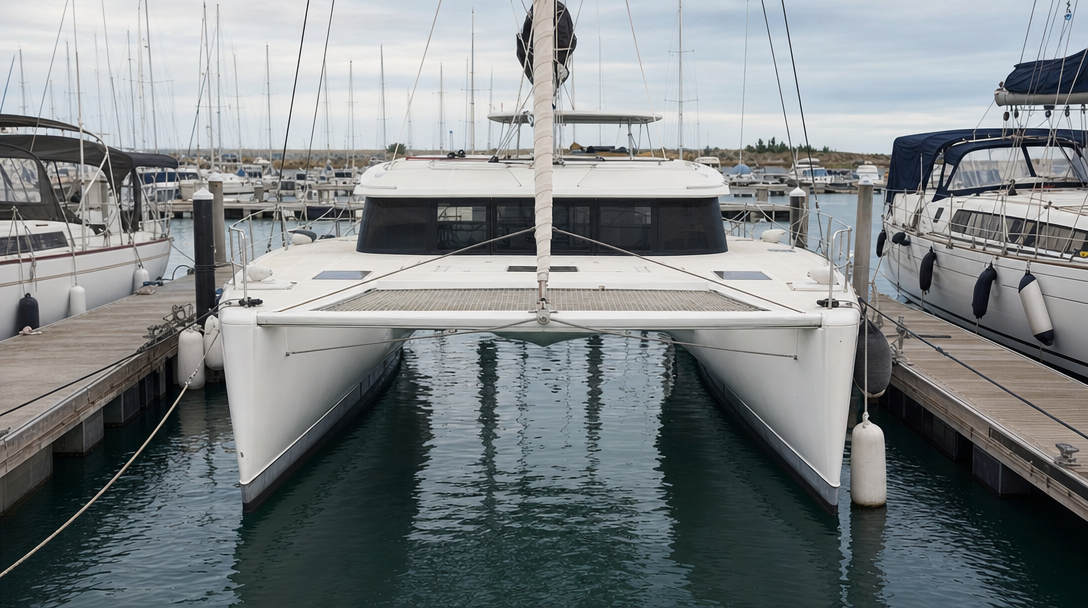
The main advantage of the two hulls is their available volume. A 44-foot catamaran offers living space comparable to a monohull of approximately 53 feet. Cabins are spaced apart on the floats, providing privacy, the salon is flooded with light, and the draft allows for close approach to the beaches.
| Indicator | Catamaran | Monohull | What does this mean? |
|---|---|---|---|
| Comparable volume | 44 feet | About 53 feet | More living space in a shorter length |
| Cruise boat draft | About 3-4.5 feet | About 6-8 feet | A catamaran has better access to shallow water areas |
| New boat about 40 feet | Approximately 400,000–1,000,000 | Approximately 200,000–500,000 euros | A catamaran requires more start-up capital. |
| Place in the marina | Often 1.5–2 times more expensive | Standard board | Width affects both cost and availability of seats. |
| Lifting and service | They may be more complicated | Fits better into existing infrastructure | Not every shipyard can accept a wide hull. |
When assessing the cost of owning a catamaran, it's important to consider more than just the starting price. Double the number of engines, rudders, life support systems, and long lines complicate maintenance. Annual maintenance is often estimated at around 10% of the vessel's price, and due to the high starting price, the absolute costs of a multihull are significantly higher.
The vast interior space encourages owners to accumulate belongings. Water, fuel, tools, and appliances sink the hulls deeper into the water. The wetted surface increases, speed decreases, and bridge deck clearance decreases. A multihull vessel requires strict weight management: its performance is maintained only as long as the weight remains within the design limits.
Before signing a contract, it's a good idea to calculate berthing costs, find a suitable lift in the sailing area, check the route's depth, and realistically estimate the amount of luggage on board.
How to choose a boat based on your scenario, not the overall rating
When trying to determine the best type of vessel, it's helpful to shift the focus from the yacht's features to your own travel plans.
- Sail control: If your priorities are close-to-the-wind performance, clear rudder response, roll as a load indicator, and classic interaction with the boat, choose a monohull.
- Crew life: For family, entertaining, separate recreation areas, and a flat deck for everyday use, the catamaran offers an unrivaled level of comfort.
- Route: The shallow draft of a multihull allows it to enter shallow lagoons; the deep ballast keel of a monohull performs more reliably in open water.
- Budget and infrastructure: A monohull requires less expense for purchase, mooring, and repair; when choosing a catamaran, it's important to ensure in advance that local marinas and shipyards are ready to accommodate this width.
- Risk Attitude: It is necessary to soberly evaluate the monohull's ability to self-repair and the high initial stability of the catamaran, without considering any of the designs as guaranteed protection from a storm.
It's not the case type that wins, but the right set of compromises. A monohull yacht remains a balanced instrument for those who value efficient upwind performance, transparent feedback, and moderate operating costs. A multihull brilliantly addresses the challenges of cruising: it offers ample space, a flat platform, access to shallow water, and high average speeds at full speed.
How do you choose between a monohull and a catamaran before purchasing? Set your sights: what courses will you be sailing on for most of the trip, who will be living on board for weeks, and are you willing to pay for double berths in the marina? A monohull is a boat that teaches. A catamaran is a boat that hosts. Neither role is superior to the other, as long as it aligns perfectly with your purpose.