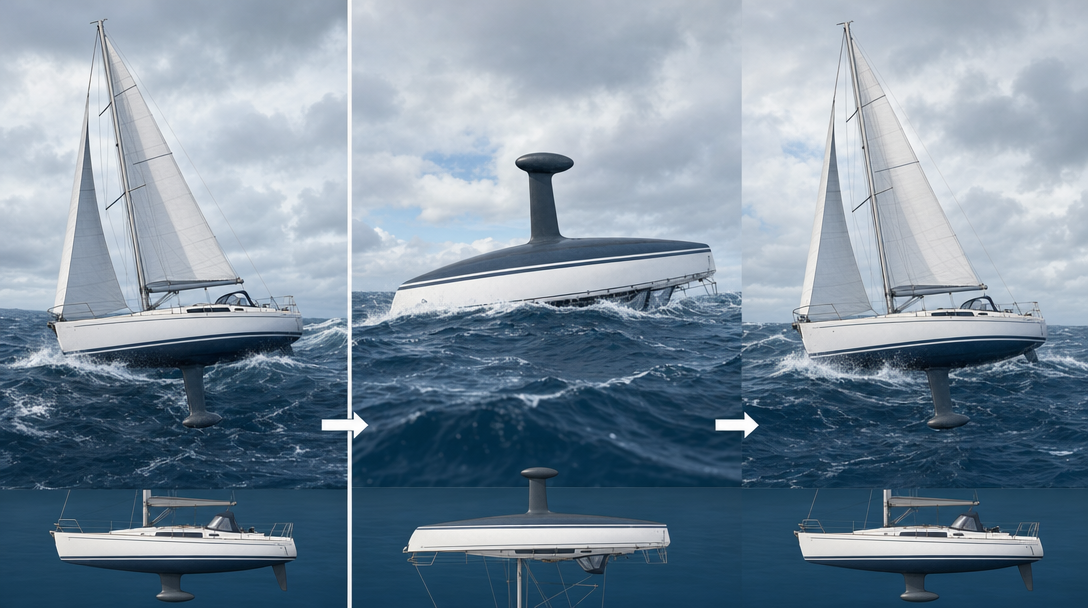
During a rescue operation in the Southern Ocean, Pete Goss's 12-meter yacht was engulfed by a collapsing wave. The vessel performed a full 360-degree roll, ending upside down for a few seconds, and then righted itself on its own just eight seconds after the capsize.
A logical question arises: how do sailing yachts survive such impacts in ocean storms, and why don't small vessels remain upside down in the water? The secret lies not in a single universal element, but in a rigorous sequence of engineering barriers: from a low center of gravity to a watertight hull and the autonomy of internal systems.
Why doesn't a yacht capsize from the first strong gust?
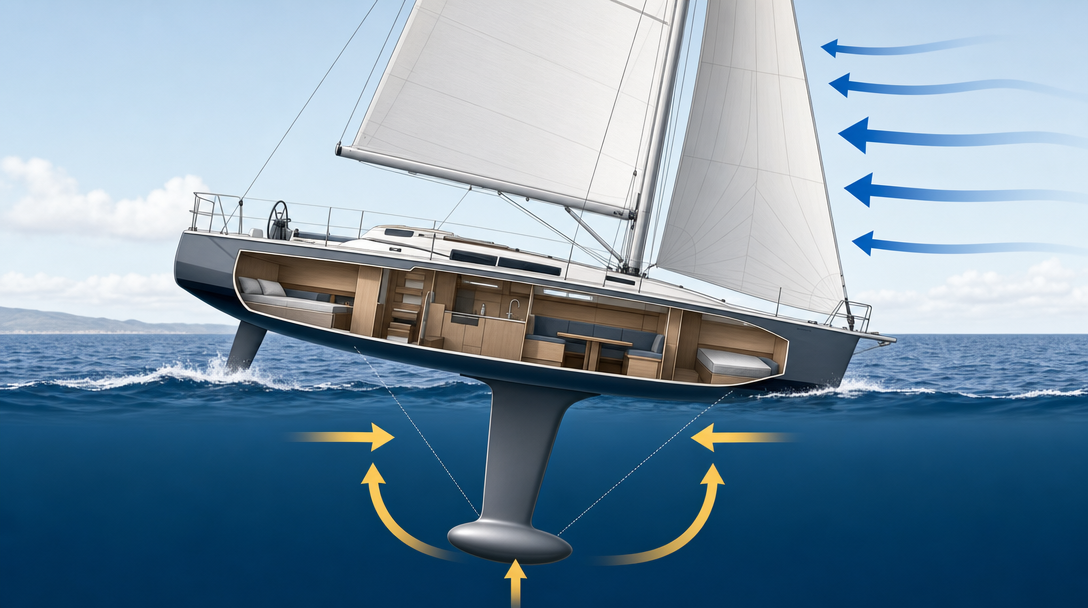
A tall mast and full sails act as a giant lever, constantly trying to capsize the vessel. Therefore, the yacht's basic stability is established at the center of gravity calculation stage. Naval engineers deliberately lower it as low as possible by hanging a false keel—a sturdy fin with a heavy bulb at the end—under the hull.
The mass of such a lead or cast iron droplet can reach 40% of the vessel's total weight. As soon as the wind tilts the hull, the heavy counterweight shifts in the opposite direction. Gravity pulls the bulb downward, creating a righting moment—a physical force that quickly returns the boat to an upright position.
The mechanics are identical to those of a child's tumbler toy: the more an incoming wave tilts the boat, the more the multi-ton load resists the roll. However, the capabilities of the false keel are strictly limited by the parameters specified during the design.
More radical solutions exist. Michel Desjoyeaux's racing yacht, during the 2001 Vendée Globe race, featured a swinging false keel. Powerful hydraulics forced the counterweight to deflect up to 40° to windward. When wind speeds exceeded 45 knots, the artificially increased righting moment allowed the boat to sail confidently through the storm with minimal heeling.
Where does sustainability end? What does AVS mean?
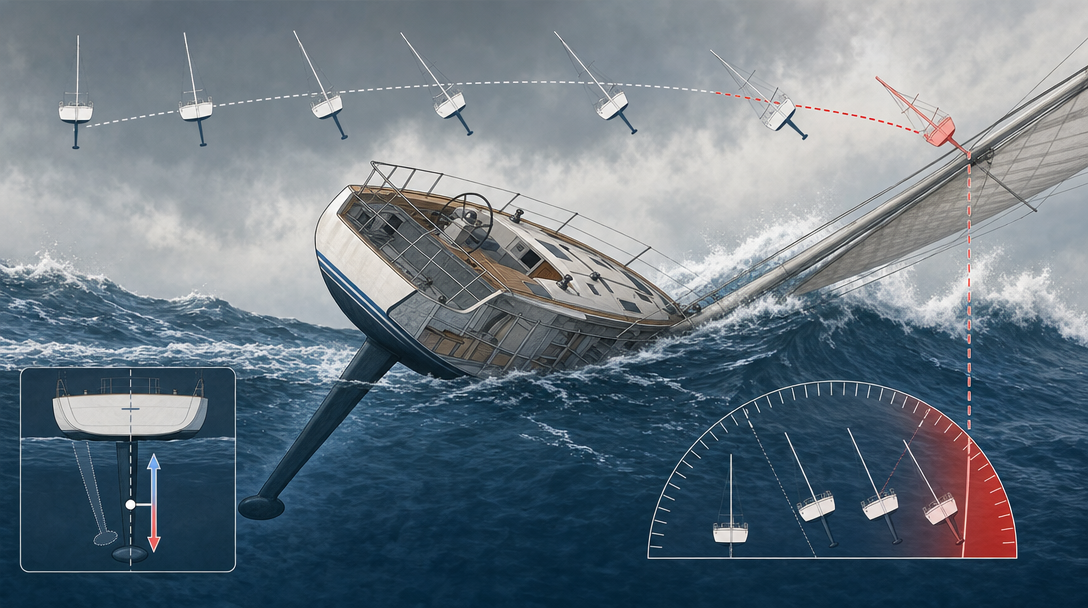
The righting moment cannot increase indefinitely. In hydrodynamics, there is a critical point—the angle of vanishing stability (AVS). This is a calculated physical limit, beyond which the conventional balance system ceases to function, and the righting moment arm drops to zero.
While the ocean swell heels the vessel at 30, 60, or 80 degrees, the massive counterweight successfully counteracts the tilt. But if the wave pushes the hull even lower, the physical lever of stability rapidly diminishes.
The moment the masthead hits the water, the boat reaches a critical threshold. If the next storm surge exceeds the AVS angle, the gravity vector shifts. Now the enormous weight of the mast, deck, and internal mechanisms begins to help the storm pin the vessel upside down.
Crews experienced this physical limit during the tragic 1998 Sydney to Hobart Race. Hurricane-force winds of over 80 knots whipped up fifteen-meter-high waves. Rising up the steep crests, yachts lost their footing, slid down, and overshot the critical angle. Many boats foundered, and five vessels passed the point of no return and were left helplessly floating upside down.
How a sealed hull maintains buoyancy after a capsize
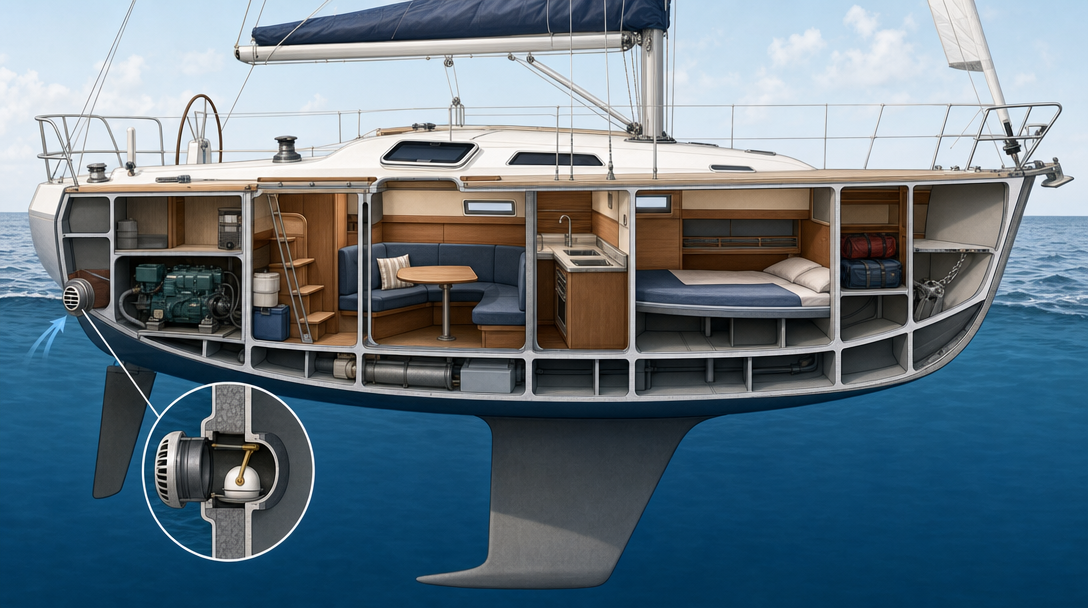
When the mast submerges, the boat becomes a semi-submerged object, weighed down by tons of water. To prevent instant flooding, the yacht's watertight hull is designed as an insulated capsule. The main deck hatches and hoods are fitted with thick marine seals and powerful pressure locks. Air intakes and ventilation shafts are often equipped with float valves: when a wave approaches, a lightweight ball inside the valve floats and seals the channel.
Additional safety is provided by dividing the interior space with strong, watertight bulkheads. By sealing the hatches between compartments, the vessel becomes a series of isolated zones. The resulting enclosed air volume acts as a rescue float, pushing the boat to the surface.
In 2013, French skipper Jean-Pierre Dich lost his entire multi-ton false keel in the Southern Ocean. Without counterweight, the lightweight boat instantly capsized. However, the skipper managed to close the main entrance hatch and the bulkheads beforehand. The insulation prevented any water from entering, allowing the hull to remain afloat until rescuers arrived.
How the hull and mast withstand the impact of ocean waves
The impact of a multi-meter-high, collapsing ridge on the side of the hull creates a colossal point load. To prevent the skin from cracking in the first seconds of a storm, the composite hull of a sailing yacht is formed as a multi-layer sandwich. The outer and inner layers are glued together using durable carbon fiber or Kevlar, with a porous core of dense polyurethane foam or Nomex baked in between.
The rigid carbon fiber absorbs enormous tensile forces, while the foam core absorbs the water's kinetic energy. Under strong impact, the inner layer compresses slightly, working like the crumple zone in modern cars. This physical property explains how the yacht withstands high wave impacts without critical damage to the hull.
In 1999, Yves Parlier's yacht was caught in a storm in the Indian Ocean. The vessel repeatedly broke free from the crests of forty-meter-high waves and crashed into the ocean trenches. Despite the brutal impacts, the multilayer composite armor withstood the stress without a single delamination.
The vertical stability of the enormous mast is ensured differently. The slender tube is supported by standing rigging: a web of steel cables, stays, and precisely pre-tensioned shrouds. When a strong gust of wind occurs, the mast bends in a controlled arc, releasing excess pressure and transferring the load downwards into the step. But this engineering chain is unforgiving of weak links. In 2016, on Stéphane Le Diraison's yacht, the crimped end of one of the shrouds cracked due to metal fatigue. Deprived of lateral support, the carbon fiber mast broke in three places and instantly fell overboard.
What happens to a yacht after a complete capsize?
The most extreme scenario is a complete 360-degree rotation of the yacht around its longitudinal axis. When the boat stops upside down, hydrostatic forces take over. The spacious cabin and sealed hull displace water, creating an upward buoyancy force. At the same time, the multi-ton bulbous body is high in the air, causing gravity to pull the keel back down.
This position is extremely unstable. As soon as another storm wave gently pushes the overturned hull sideways, the heavy false keel snaps downward. It spins the vessel with tremendous acceleration, clearly demonstrating how a yacht returns to its original position after a capsize. For Pete Goss, this process took only seconds, although a successful outcome always depends on the specific architecture of the vessel and the integrity of the hull.
A violent roll onto an even keel creates internal chaos. Unsecured equipment becomes flying projectiles, and heavy batteries, if released, can damage the hull from the inside. To prevent disaster, the interior is designed to strict standards: batteries are secured in steel frames, wiring is concealed in watertight channels, and incoming water is pumped out by independent pumps.
The effectiveness of this redundancy saved Ellen MacArthur during her solo circumnavigation. After a wave struck in the Southern Ocean, seawater gushed through a damaged hatch. Emergency pumps, located in isolated electrical circuits, were automatically activated by float switches and continuously pumped hundreds of liters overboard while the skipper repaired the leak in the dark.
How an autopilot helps a crew survive a protracted storm
The last vulnerable link in the battle against the elements remains the human. The vessel must be constantly maintained at a safe angle to the oncoming waves, avoiding side impacts. When a hurricane rages for several days straight, the skipper inevitably becomes exhausted and loses concentration. In such situations, the yacht's autopilot takes on the most grueling task of maintaining course during a storm.
The control processor receives data from high-precision gyroscopic sensors. By reading hull acceleration dozens of times per second, the algorithm detects the onset of a dangerous skid on a crest and instantly sends a command to the hydraulic rudder drive. During the extreme 2020–2021 Vendée Globe race, it was the smart electronics that guided the boats through the hurricanes of the Southern Ocean, when the exhausted sailors were no longer physically able to stand watch.
Why a yacht's survival depends on the entire system
A modern sailing yacht can withstand the ocean's fury thanks to a complex set of precise engineering calculations. A false keel and multi-ton bulbous hull provide a powerful righting moment until the heeling force reaches the critical AVS limit. A multi-layer composite hull and flexible rigging absorb the impact energy, watertight hatches and bulkheads transform the cabin into a lifeboat, and redundant electronics and emergency pumps help cope with the consequences of a capsize.
When assessing a vessel's readiness for extreme voyages, it is worth considering four key questions:
- What exactly will bring the boat back from a list?
- Where is the calculated limit of hull stability?
- What will stop water from getting inside if it tips over?
- What emergency systems will continue to function in the event of a complete failure of the main network?