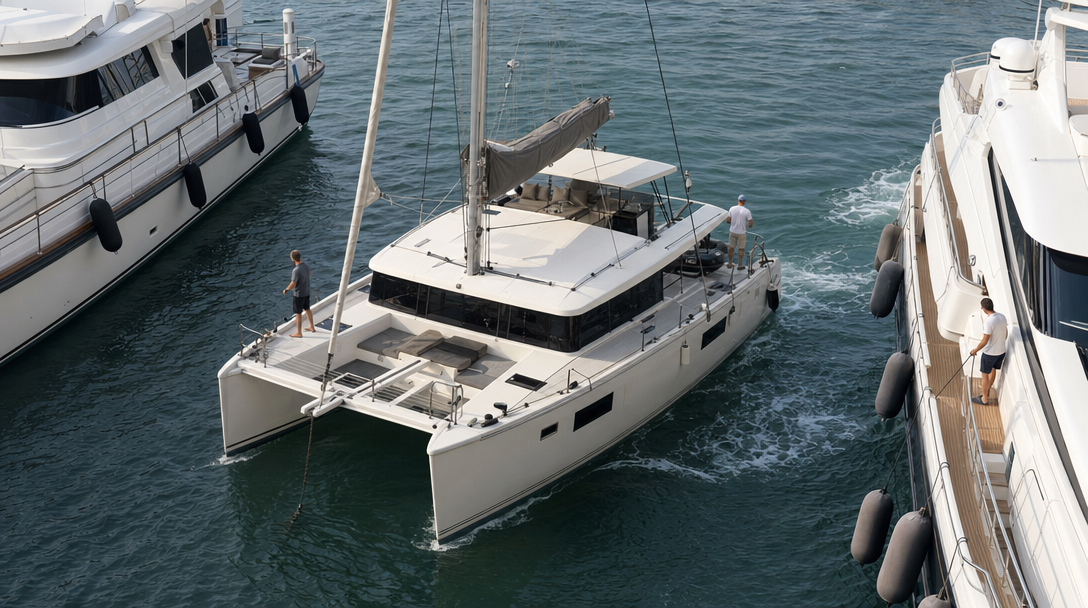
What happens when a 55-foot catamaran is forced to navigate between larger yachts in a 25-knot crosswind? From the flybridge, visibility is poor, there's limited space nearby, and the crew must simultaneously manage the anchor, two engines, and the distance to adjacent sides.
In this situation, both the advantages and disadvantages of a twin-hulled boat become apparent. A sailing catamaran offers more space, is suitable for shallow waters, and maneuvers precisely with two engines. However, the lack of a keel increases drift, making it more difficult to sail upwind, and the costs of rent, fuel, and marina berth are higher. Let's explore who is suitable for this type of vacation and what to consider before heading out to sea.
Why choose a catamaran for a spacious vacation?
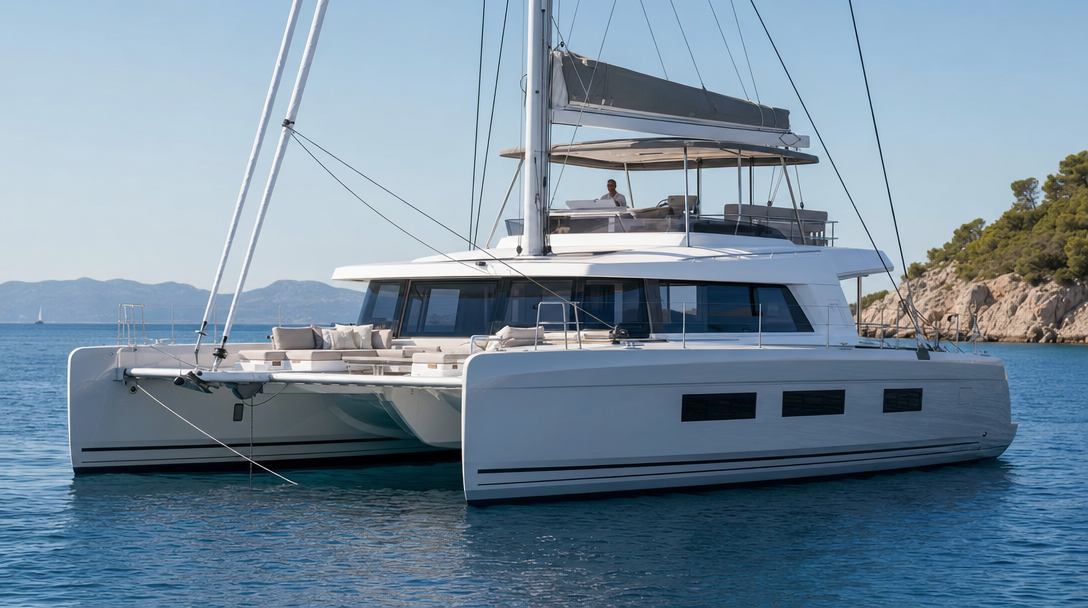
The catamaran consists of two floats connected by large beams. This provides more interior and exterior space onboard than a monohull sailing yacht with comparable use. When a large group is on board, the difference is especially noticeable.
The floats house cabins, each with its own shower and toilet. Between the hulls is a full-fledged saloon with a kitchen area, sink, gas stove, refrigerator, and a large table. People can use the various spaces simultaneously, without crowding into one cramped space.
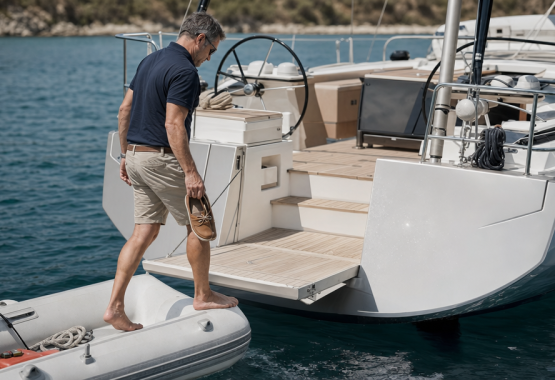
There are also several open areas: a swimming area aft, a separate seating area forward, and a flybridge with a helm station and seating area above. When moored, the forward platform allows you to sit on the bow, out of the normal line of sight of people walking along the pontoon.
The large area allows for the installation of equipment for self-sufficient recreation: a generator, water maker, solar panels, larger tanks, additional refrigerators, and an ice maker. The advantages of a catamaran here are related to everyday life: there's more fresh water, food storage, and space for a large group, but the sheer volume doesn't make the boat any more sporty under sail.
Shallow draft expands the choice of berths, but increases costs
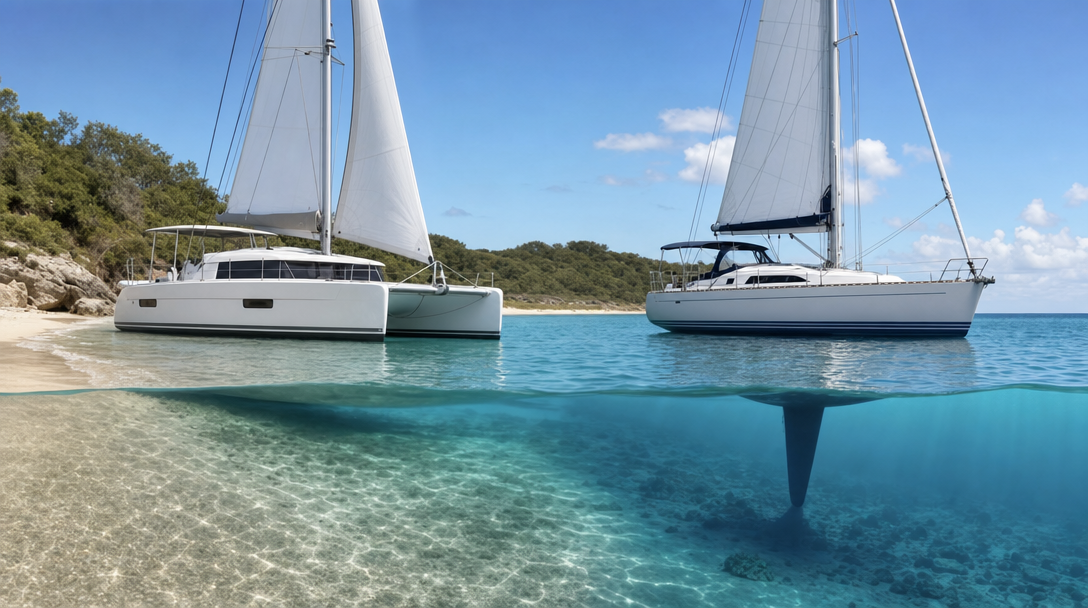
A shallow-draft catamaran is convenient in areas where water depth limits access to the shore. It can approach the beach closer than a keeled yacht, offering more options for anchoring near the shore and navigating shallow waters. However, approaching the beach entirely is not an option: in the original example, a distance of less than two meters from the shore was already considered too close.
If your route passes through shallow waters, a shallow draft becomes a practical advantage. Before chartering, it's worth comparing the depths and features of your intended anchorages with the capabilities of your specific catamaran.
The downside of more space is expense. A catamaran takes up more marina space, has two engines, and consumes more fuel. The author estimates the overall cost of this format to be approximately twice that of a standard yacht, attributing the difference to the vessel's volume, berthing space, two engines, and more equipment. The average seasonal rental price ranges from €5,000 to €12,000 per week, depending on the catamaran's size and location. This is a guideline for the scenario described, not a one-size-fits-all rate.
What changes under sail due to the absence of a keel
A catamaran has no keel. According to the author, a keel creates a righting effect when the boat heels and counteracts drift. Without a keel, a catamaran is more susceptible to wind drift, and it's more difficult to maintain a headwind course.
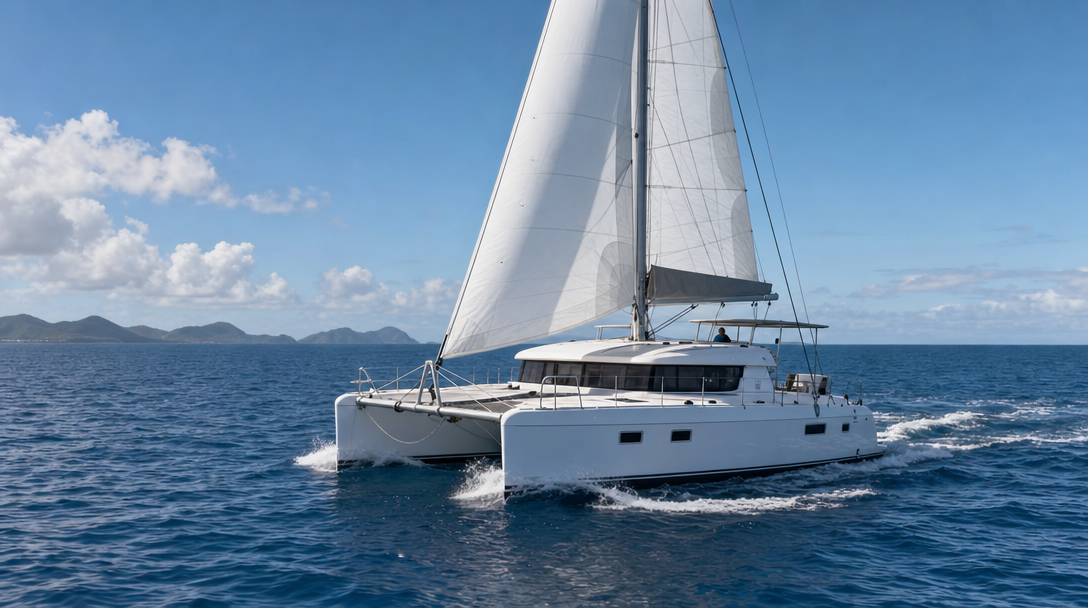
The author estimates the tacking angle of a sailing catamaran when sailing upwind at 150–160 degrees. This is his estimate, and it can't be automatically applied to all twin-hull boats. The overall effect is more important for selection: a catamaran drifts more upwind, which is why engines are often used on such boats.
With a tailwind, the situation changes: the catamaran can reach speeds of up to 17 knots. According to the author, this is precisely the speed at which its performance is best demonstrated. However, the almost complete absence of heel deprives the crew of their usual visual reference—the tilt of the hull makes it more difficult to assess the load on the sails.
Safety when sailing a catamaran is crucial here, as it requires early reduction of sail area. Reefs should be taken promptly, without waiting for a noticeable heel. The author warns that if the heel is excessive, the catamaran may capsize and, in his opinion, will be unable to right itself. This warning is based on his experience and does not automatically apply to any model, regardless of its design and conditions.
How two engines help maneuvering and docking
Mooring a catamaran is more difficult due to the hull's width and limited visibility. The helm station is often located on the flybridge, high above the water, and from there, the outermost dimensions are not always visible. Therefore, in the author's personal experience, assistants stood to the right and left: one person steered, while the others reported the distance to the pontoon or the adjacent side.
However, two engines offer an advantage in confined spaces. At the same RPM, the catamaran goes straight. The difference in thrust between the right and left engines changes direction, and the opposite thrust—one engine forward and the other back—turns the boat almost in place.
- Moving forward. Both engines are running forward, and the catamaran is heading straight. Direction is adjusted by adjusting the RPM of the right and left engines.
- Backward movement. Both engines are engaged in reverse. The catamaran moves stern-first without any noticeable roll, which the author attributes to the characteristics of a monohull yacht.
- Turn on the spot. One engine runs forward, the other backward. The catamaran rotates until the thrust is equalized.
- Turn in an arc. If both engines are working in the same direction but with different thrust, the catamaran will move in a wider or narrower arc. The greater the difference in thrust, the more noticeable the turning effect.
- Anchor adjustment. In the author's experience, varying the thrust helped shift the catamaran relative to the anchor and compensate for drift. This is a personal technique, not a universal procedure for all conditions.
The author also describes steering the engines only with the steering wheel locked. He tightened the steering wheel nut, and if it didn't hold the wheel, he asked an assistant to hold it straight. This technique is based on the author's personal experience and is specific to a specific boat.
Mooring in confined spaces
A telling episode occurred when a 55-foot catamaran was entering a marina, where there was a space roughly the size of the catamaran itself between the larger yachts. The crosswind reached 25 knots. The crew moved out, dropped anchor, and began gradually moving back, using the chain and the difference in engine thrust.
Once the anchor was in place, the catamaran began to be brought into position with minor adjustments. If necessary, one engine was turned off and the other was put into reverse to adjust the hull's position. At the right moment, the crew released two meters of anchor chain, after which the boat was moved and moored between the neighboring yachts.
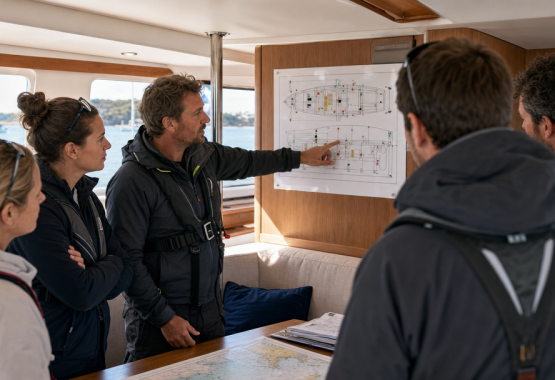
This episode describes specific work with gauges, an anchor, and two engines, but does not guarantee safe mooring under other conditions. Before the maneuver, it is necessary to determine who is in control from the flybridge, who is observing both parties, and how commands are communicated.
Who is suitable for this compromise between comfort and control?
A leisure catamaran is designed primarily for a large group, where private cabins, a spacious saloon, multiple outdoor areas, fresh water, and additional equipment are essential. This type of boat provides a comfortable platform for extended stays on board, especially if the route involves shallow waters.
Another option is to choose the more familiar dynamics of a sailing yacht and lower costs. A monohull yacht doesn't offer the same amount of space, so comparing boats requires more than just square footage. Charter cost, marina space, fuel consumption, upwind performance, and the crew's willingness to handle a wide hull are all important factors.
Before choosing, it's important to weigh four factors: how many people will be using the boat at a time, whether mooring near shallow water is necessary, whether the crew is prepared to reduce sail area in advance, and whether they are skilled at handling two engines when mooring. If comfort and space are a priority, a higher price may be a conscious compromise. If cost and familiarity under sail are more important, a sailing yacht may be a better choice.
Sailing Catamaran: What to Check Before Choosing
A sailing catamaran is suitable for large groups and shallow waters. Its advantages include space, shallow draft, and precise maneuvering with twin engines. However, its limitations are also significant: higher cost, higher fuel consumption and marina fees, significant downwind drift, the need to reduce sail area earlier, and a well-organized crew when mooring.
Before renting, it's helpful to answer four questions:
- Does your company need spacious cabins and multiple recreation areas at the same time?
- Is the shallow draft suitable for the depths and anchorages of the proposed area?
- Are you prepared to take into account the lack of a keel and reef in advance, without relying solely on the heel?
- Are there people on board who can control the dimensions and operate two engines during mooring?