You're offered the option of registering your yacht under the Latvian or Dutch flag, and they promise that European registration will allow you to avoid paying VAT. Should you accept? A registration certificate confirms the vessel's connection to the flag state, but it doesn't change its tax status.
A flag is necessary for interaction with authorities, insurance companies, and marinas. Therefore, yacht registration begins with verifying the owner's residency, purchase history, ownership documents, and future expenses—and only then does it proceed to comparing registries.
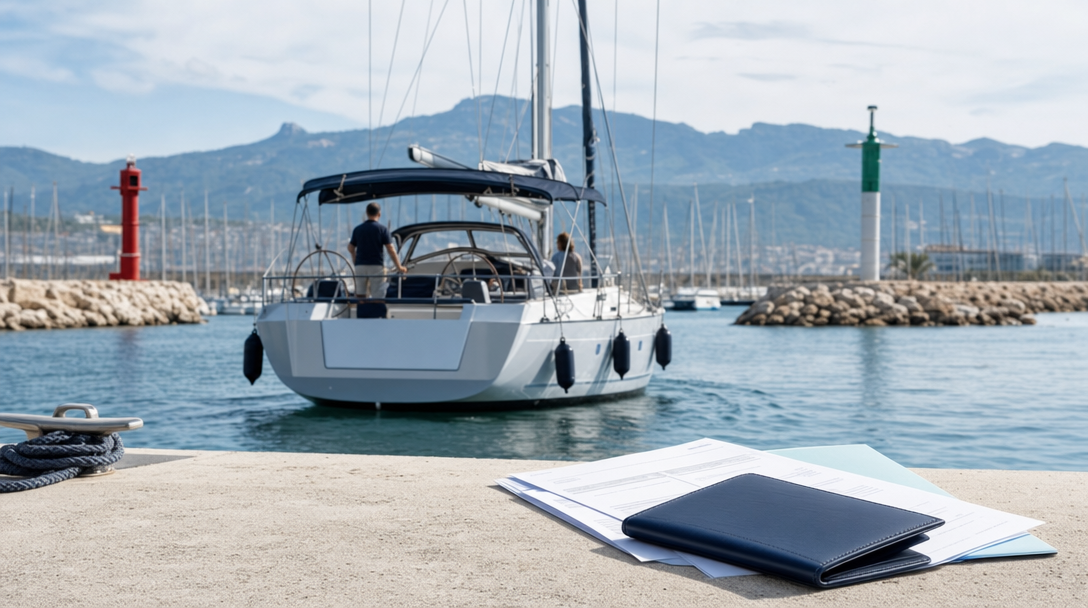
First, check the yacht's ownership status and tax history.
Before choosing a registry, determine the owner's residence. Then, determine whether European VAT has been paid on the yacht and how it entered the country. This information affects not only the possibility of registration but also the vessel's residency.
Registration is not the same as paying tax. A yacht can fly a European flag and still have unpaid VAT. Therefore, suggestions to register a Latvian or Dutch flag as a way to avoid paying European VAT require particular caution: if the yacht is actually imported into Europe, the registration certificate does not eliminate the tax liability.
For yachts without paid European VAT, a temporary importation scheme applies: typically, they must exit territorial waters approximately every 18 months and then re-enter. This is not a universal period for all countries and circumstances. A yacht can stay in Turkey for up to four years upon payment of a transit permit—a permit to navigate local waters.
A longer stay is sometimes necessary for repairs, maintenance, or illness. In such cases, the yacht is raised, and the circumstances are documented. The conditions of a specific jurisdiction should be verified in advance.
For European residents, the simplest route is to pay VAT and register under the flag of their country of residence. The benchmark for European countries is approximately 17 to 25 percent, most commonly 19–20 percent, but the current rate should be verified separately.
Before comparing registries, ensure you have five pieces of information: residency status, customs clearance, proof of VAT payment, the yacht's country of residence, and the duration of its temporary import. Without this verification, even an accessible flag can raise questions about the vessel's subsequent stay.
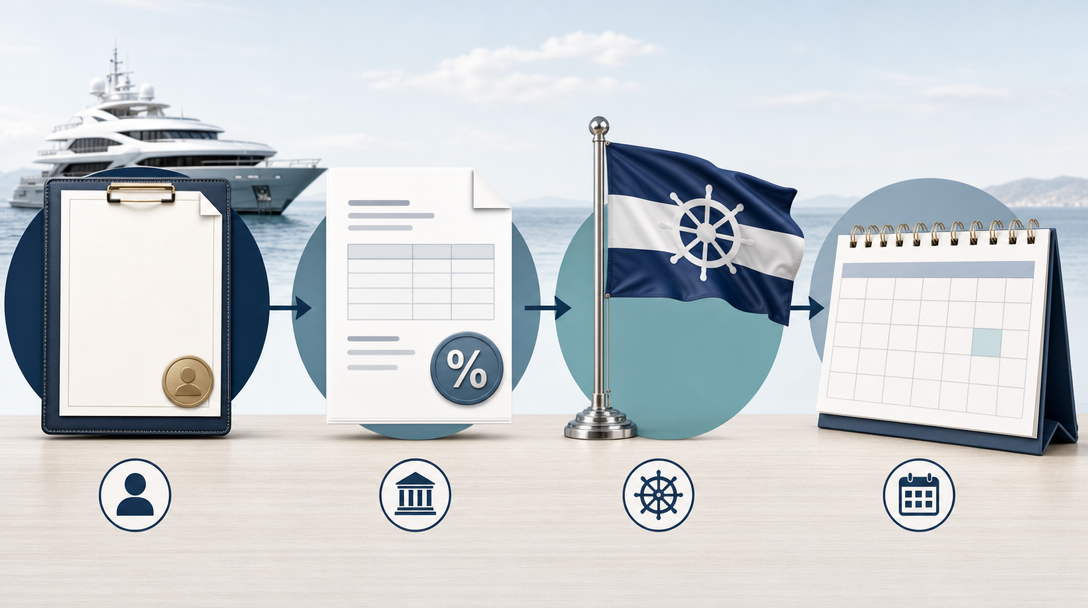
Compare flags by availability, reputation, and overall cost
Registries can be open or closed. In closed registries, registration is available to residents of the country—individuals or legal entities. Open registries allow foreigners. For non-residents, this means that along with the flag, they may have to establish a legal entity and account for its annual maintenance.
The Paris Memorandum of Understanding (PMOU) rating divides flags into white, grey, and black lists based on the results of inspections and detentions. For a private yacht, this indicator is less significant, as the rating primarily applies to merchant marine. It's more important to verify whether the registry, ownership documents, and insurance are recognized in the intended locations of operation and sale.
| Jurisdiction or option | Availability and duration | Cost guideline | What to check |
|---|---|---|---|
| British Insular Jurisdictions | Suitable for non-residents; registration is often valid for about 10 years | Company maintenance costs are approximately 300–1000 euros per year | The need for a closed registry for a company |
| Jersey | British Insular Jurisdiction | Around 7,000–8,000 euros for a set with company organization | If you have a company, the cost can be about half as much. |
| Georgia | Registration for foreigners for 3 or 5 years | Approximately $1,500–$4,000 | The reputation of the young flag and the conditions for renewal |
| Montenegro | Registration for 4 years; temporary - up to 3 months | Around 1000–2500 euros; survey inspections – 500–1500 euros | Need for inspection or visit for renewal |
| Panama | Open neutral jurisdiction | The amount depends on the terms of registration | Current fees and registry requirements |
| Liberia | Registration without expiration date | Annual yacht tax | The amount of the annual payment and the procedure for its calculation |
| Malta | Registration by individuals and legal entities is possible in the described scheme. | The amount depends on the leasing terms and tax regime. | Conditions for yachts over 15 meters in length and the legality of a specific scheme |
British island jurisdictions are being considered as options for non-residents. A closed register requires a Commonwealth company or other suitable structure. The validity of the registration does not waive the company's maintenance costs and fees.
Georgia is an option for foreigners, but its flag doesn't yet have the same reputation as the British ones. In Montenegro, a yacht can be registered to a non-resident individual, and the price includes registration and related fees. The choice of flag for a yacht should be based on a combination of factors: availability, term, initial price, annual fees, inspections, and the implications for insurance and sale.

Which flags and registration schemes should you avoid?
The European flag does not replace VAT. The Dutch and Latvian flags may be advertised as a way to register a yacht in Europe without paying VAT, but registration does not change the fact of import. If the VAT is not paid, the owner faces problems with the yacht's continued presence.
Tax records should also be checked when purchasing a used yacht. A vessel purchased from a private owner with confirmed VAT status differs from a yacht purchased from a charter company. A charter yacht can be treated as a means of production, so its tax status cannot be automatically equated to that of a regular privately owned used yacht.
Another risk is associated with simplified registries. Registering in Delaware for approximately $200 may provide a registration card but not full proof of ownership. This can complicate insurance and raise questions from counterparties during a sale.
Caution is also required with cheap registries in countries that don't issue full paper certificates. This carries the risk of simultaneously registering the yacht elsewhere, as well as questions from authorities, border guards, and the coast guard. Before skimping on the fee, check what document confirms ownership, whether it is recognized by insurers, and whether the chosen flag will create difficulties when selling.
The search for "yacht registration without VAT" shouldn't be interpreted as a search for a tax loophole. Certain schemes, including the aforementioned Maltese leasing for yachts over 15 meters, depend on the terms of the transaction and are not a universal way to reduce taxes.
Prepare documents, insurance, and expenses before applying.
The package of documents depends on the registry, but it is convenient to prepare them in a certain sequence:
- Confirm ownership. For a new yacht, this is a Builder's Certificate. For a used vessel, a Bill of Sale or a Purchase Agreement (MOA) will suffice.
- Check previous registration. A used yacht will usually require a certificate of deregistration. A certificate of no encumbrances may also be requested.
- Prepare the owner's documents. Individuals need a copy of their passport and a yacht registration application. Documents for a radio license are processed separately.
- Please clarify additional requirements. The registry may request insurance, a classification society certificate, a survey report, or other documents. If the owner is not present in person, a power of attorney for the agent will be required.
- Check temporary documents. Many registries initially issue a temporary certificate for approximately three months. This may already contain the permanent registration number while the original certificate is being processed.
- Calculate insurance. Compulsory third-party liability insurance typically costs between €100 and €400. Full comprehensive insurance, in the above-mentioned guidelines, costs between €0.5 and €1.51 times the value of the yacht and equipment; the price is affected by the deductible, which is the portion of damage the insurance company does not cover.
Liability insurance is usually obtained after registration, although some registries may request it in advance. Before submitting your application, inquire not only about the registration fee, but also about the costs of the surveyor, the company, renewal, insurance, and obtaining the original documents.

Submit the design to the agency only after checking its scheme
The agency can submit documents by proxy if the owner is not present in person. Their role is not limited to simply filling out the application: the intermediary must explain the tax implications of the chosen flag and provide a full cost estimate.
Before entering into an agreement, check the company's reputation and experience, the scope of services, the procedure for obtaining temporary and permanent documents, ownership requirements, and possible annual fees. Be especially wary of offers that promise tax waivers without a clear explanation of the legal consequences. An unlawful scheme can lead to financial losses, insurance issues, and even the loss of the yacht; for a complex purchase, seek the assistance of a professional lawyer.
What to check before registering a yacht
The appropriate flag is determined by the specific yacht and owner. Registration confirms the vessel's affiliation with the flag state, but does not replace VAT payment or correct any gaps in the ownership history.
Before paying for the design, please answer four questions:
- What is my residency status and where is the yacht located?
- Has VAT been paid and is this supported by documents?
- Which registry is chosen: open or closed, and are its documents sufficient for insurance and sale?
- Does the full quote include registration, company, renewal, inspections, insurance and related fees?
If there is no clear answer to any question, first request documents and a legal explanation, and only then choose a flag and submit an application.