Imagine two yachts in front of you: a lightweight charter boat with a modern sandwich hull and a heavy aluminum cruiser. Both look great on the shore, but their lifespan, cost of ownership, and damage tolerance are designed for completely different purposes.
If you want to understand how to choose a yacht hull material, don't look for the most durable option. It's much more important to honestly determine the route, operating conditions, and your willingness to handle repairs. A boat that will be resold after seven to ten years of coastal chartering doesn't need the same level of durability as a vessel designed for ten years of ocean-going voyages.
What requirements for the case determine the choice of material?
The hull is constantly exposed to water, air, pressure, and the biological environment. At the same time, it must maintain the boat's internal space and work in conjunction with the structural frame—the internal skeleton. A self-supporting shell for a yacht's size would require excessive thickness, weight, and enormous financial investment.
When evaluating a yacht's hull material, it's worth considering four basic criteria:
- Strength and rigidity. An overly flexible hull loses its durability faster, so not only the properties of the casing itself are important, but also the rigidity of the entire assembly.
- Compatibility. Errors in the combination of different elements within the structure dramatically reduce the service life of the housing.
- Resistance to external environment. Water gets inside even if the boat is regularly lifted and dried.
- Price. The cost of construction or purchase cannot be considered in isolation from future maintenance costs.
These criteria will prevent a boat for a comfortable coastal lifestyle from being confused with an expedition vessel. Before you begin your search, it's worth considering where the yacht will be sailing, how long you'll be keeping it, and how much maintenance you're willing to handle.
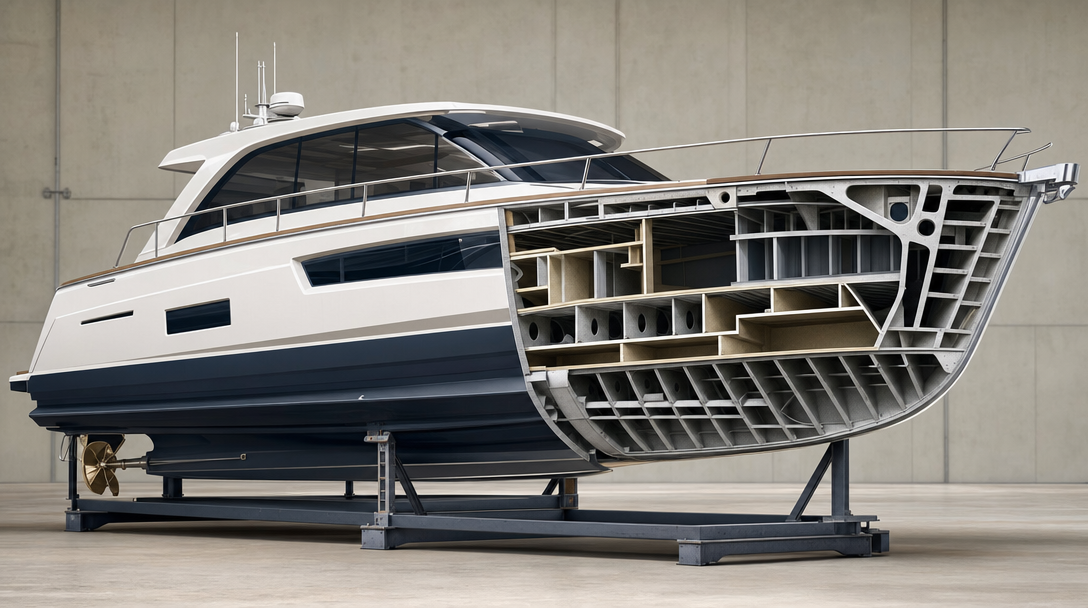
Why modern fiberglass sandwich is suitable for charter
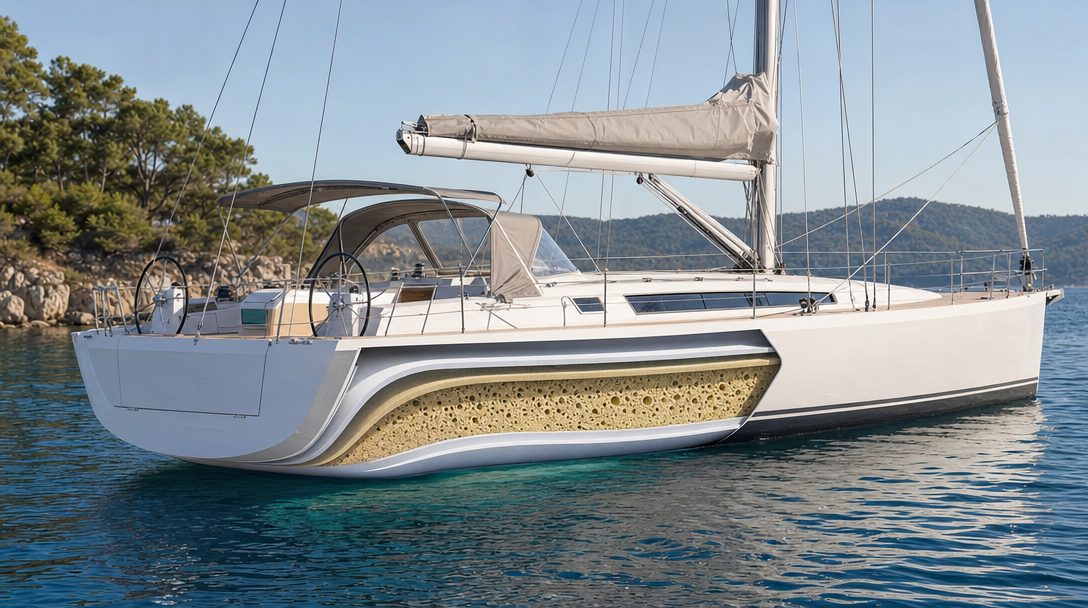
For a new boat used for coastal charter, a fiberglass sandwich—a porous core laminated with fiberglass—is the most efficient choice. This construction is lightweight, retains heat well, dampens sound, and the core itself does not absorb moisture. Furthermore, its modern design has direct commercial value: a popular boat is easier to rent out.
This choice comes at a price. The slightest flaw in the design can cause the sandwich to delaminate, and its strength is limited and not designed for rigorous testing. However, in mild coastal conditions, maximum service life is less important economically. The model's popularity among renters and low annual maintenance costs are paramount.
Charter operators replace mass-produced models approximately every seven to ten years. They decommission a boat when it becomes obsolete, rather than trying to preserve it for decades to come. An expected resale price of 50% of the original cost is precisely appropriate for this scenario.
The transition to vacuum forming technology has minimized human error, but it still requires careful inspection. Particular caution should be exercised with sandwich panels built before 2010. Back then, vacuum forming was not universally used, and balsa wood or high-density foam were used as core. Before purchasing, be sure to confirm the year of manufacture, core type, lamination method, and inspect the skin for hidden delaminations or rot.
Which hull to choose for long-distance and expeditionary travel?
The hull material for a round-the-world yacht is chosen according to different criteria. Durability, suitability for repairs away from civilization, impact resistance, and the owner's budget—either for an expensive build or for the constant battle against corrosion—are paramount.
Aluminum: An expensive option for long-term use
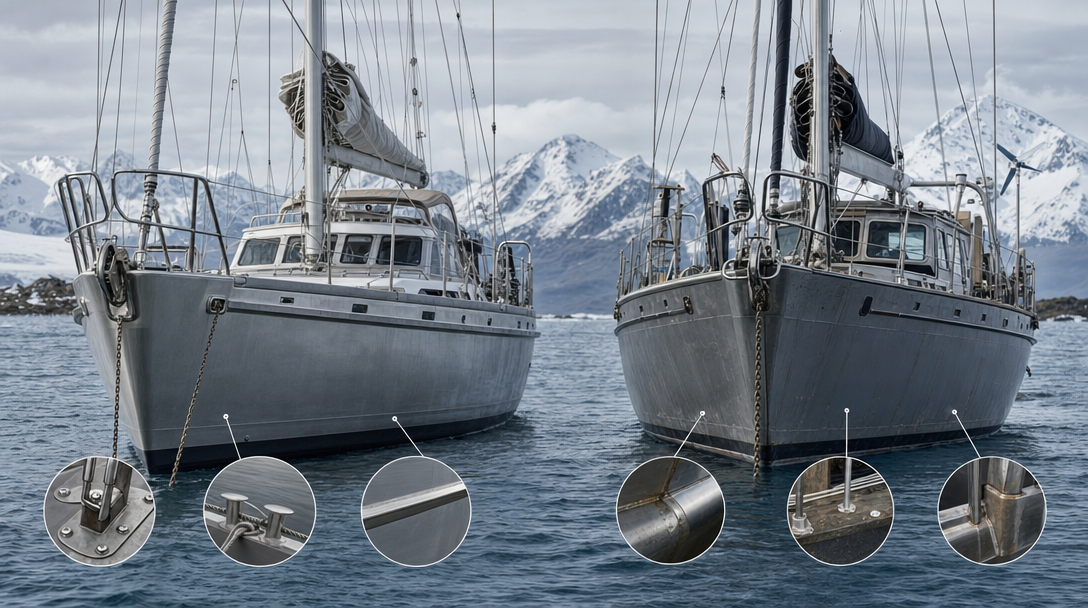
An aluminum yacht hull is distinguished by its high strength, aesthetic appeal, and relatively low maintenance. It's one of the most preferred options for round-the-world and polar expeditions, provided the budget allows for the high starting price. An aluminum hull often costs an additional €50,000, although the final cost always depends on the specific project.
The key to ensuring the longevity of such a boat is complete avoidance of direct contact between aluminum and other metals. When buying a used boat, its age is meaningless: you need to look for areas of electrochemical corrosion and evaluate the quality of maintenance. The material's obvious drawbacks include poor thermal and sound insulation, which must be compensated for by a thick layer of interior lining.
Steel: Affordable expeditionary construction with constant corrosion
A steel yacht hull is suitable for a builder on a budget who is focused on expeditions. Steel is incredibly strong, and repairs in remote corners of the world can be carried out with just a simple welder. This is why it is often chosen for ice-covered voyages when aluminum is a limited option.
The main cost of steel's affordability is persistent corrosion. Rust problems often become apparent after just five years of use: stains appear on internal welds, around hatches, and portholes. Proper maintenance slows this process, but permanently removing rust is nearly impossible. A steel boat is difficult to sell, and buying a used hull with advanced corrosion is not recommended without a thorough inspection.
A modern, thick fiberglass hull, made using vacuum infusion, is perfectly capable of handling long voyages, but not extreme ice conditions. Older polyester plastic is fundamentally unsuitable for harsh polar conditions. Therefore, when deciding which material to choose for an expedition yacht, future owners typically choose between expensive and trouble-free aluminum and affordable but rust-prone steel.
What materials are suitable for self-construction and living on board?
Wood is attractive to DIYers because the construction process and financial investment can be spread out over years. Wood is tactilely pleasing, retains heat well, and dampens sound. However, this comes at the cost of labor-intensive assembly, complex application of protective coatings, and ongoing maintenance. A wooden boat always retains internal moisture, which can lead to rotting in hidden cavities over time, and contact with fasteners can cause corrosion.
Buying a used wooden boat should be done with extreme caution. Such a hull is justified if you're buying a Turkish gulet or other authentic vessel for a commercial project, where annual maintenance is factored into the budget. However, in private ownership, old wood quickly makes sailing time feel like hours spent sanding and sealing.
Reinforced concrete still finds favor due to its low cost. A heavy concrete hull is very inert: such a massive vessel experiences the least amount of rocking in short waves. The boat is ideal for comfortable mooring during low tides and long-term berthing. The technology's weakness is its unpredictable quality. If the reinforcing mesh is exposed, hidden corrosion begins within the concrete, the extent of which is impossible to assess even on dry land.
Buying a concrete hull over twenty years old is a gamble. Age alone isn't a death sentence, but it does require a particularly thorough inspection. The resulting boat is heavy, aesthetically far from ideal, and a real pain to sell. Nevertheless, for a quiet life on board and leisurely voyages without pretensions to polish, reinforced concrete remains a viable niche option.
Marine plywood with epoxy lamination
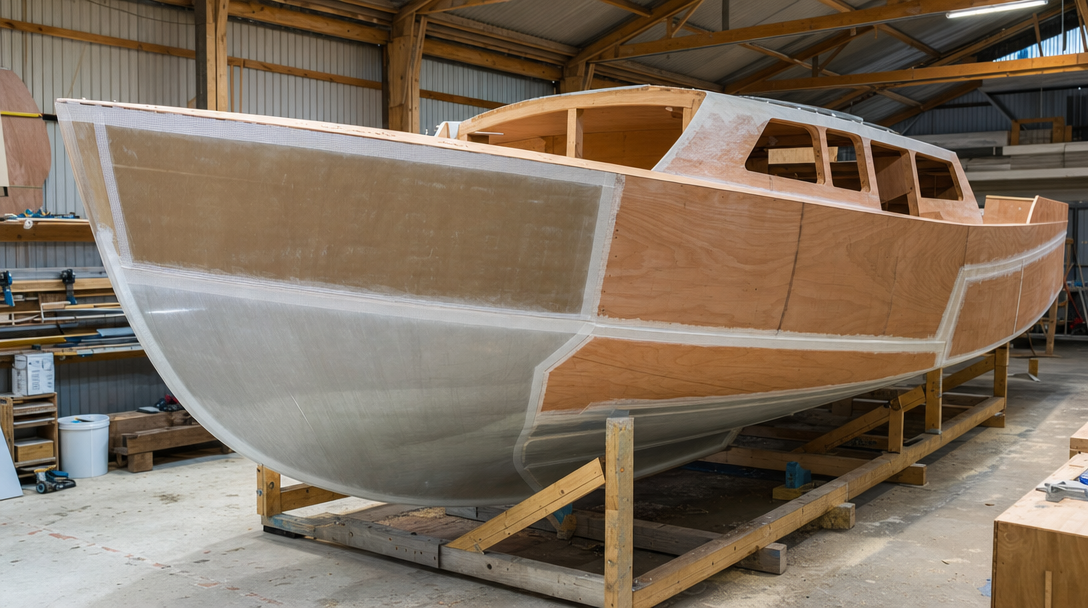
Marine-grade plywood for yacht hulls, laminated with epoxy fiberglass and sealed with gelcoat, is considered one of the most balanced solutions for DIY construction. True marine-grade plywood is free of hidden voids, assembled from moisture-resistant wood, and impregnated with special adhesives. Using regular plywood is unacceptable: it will quickly absorb moisture and turn the boat into a rotting wooden box.
This technology doesn't require expensive molds and allows for incremental assembly. Due to its high rigidity, 12 mm thick sheets are sufficient for a 50-foot boat, and 6 mm for a 30-foot boat. The epoxy resin is applied using standard rollers, and peak load areas are reinforced with carbon fiber tapes. The resulting sandwich does not rot from the inside and can withstand the harsh loads of expeditions, although it does require regular hauling to shore for drying.
The main risk of buying any plywood boat secondhand is the unknown builder's qualifications. If the hull contours were not calculated professionally, the yacht may have poor hydrodynamics. Therefore, in addition to checking the quality of the lamination and the condition of the wood, the performance of such a vessel must be tested on the water.
How to Evaluate the Fiberglass Hull and Age of a Used Yacht
A yacht's fiberglass hull is molded using epoxy or polyester resin. Absolute strength depends on the thickness and reinforcing fiberglass, not the type of binder. However, epoxy fiberglass has high adhesion and significantly better resistance to destructive osmosis, while older polyester boats require extremely careful inspection.
The durability of the outer gelcoat is directly related to the rigidity of the skin. Older, thick, hand-laid hulls are quite durable, but due to their flexibility in the waves, their protective layer deteriorates over time and allows water to pass through. Modern, thick hulls, made using vacuum infusion with the right resin modifiers, are much stiffer and can sail for over twenty years without any problems.
Age thresholds aren't a diagnosis, but rather a reason for a careful inspection. Polyester plastic over 15-20 years old is at risk, while high-quality epoxy shells 30-40 years old are often fully functional. If you want to understand how to inspect a yacht's hull before buying, use this short checklist:
- Please specify the type of resin, the thickness of the body and the method of its manufacture.
- Inspect the coating for signs of osmosis, mechanical damage and delamination.
- Check the areas around hatches, portholes and deck fasteners, and in the sandwich, check for dryness of the filler.
- Rely on the actual condition of the boat and its behavior on the water, and not on the advertised year of manufacture.
How to tailor your case selection to your scenario
The best yacht hull material is always tailored to the specific application. A porous sandwich is the most efficient choice for charters in warm waters. Aluminum and laminated marine plywood are well-suited for autonomous ocean expeditions. Steel is a boon for budget-conscious builders aiming for high latitudes. Wood and reinforced concrete work in narrow niches, provided the owner is prepared to accept constant maintenance and a difficult resale.
When making your final decision, keep in mind a simple filter: where the boat will be sailing, how long you plan to own it, and whether you're willing to pay for regular shore hauls. Any technology can fail due to manufacturing defects or poor maintenance. Material properties provide a foundation, but they can never replace a thorough inspection of a specific hull before purchase.