The boat is motored upwind. The crew undoes the mainsail ties, checks for snags, raises the sail, and only then shuts off the engine. After this, movement depends on the course, boom position, and sail shape.
To understand how to steer a sailboat, three things need to be connected: the sail creates lift, the weighted keel counteracts side loads, and the crew adjusts the angle and shape of the sails relative to the wind. A boat doesn't sail directly into the wind, so direction is gained through working courses and turns.
What happens to a boat when the wind fills the sail
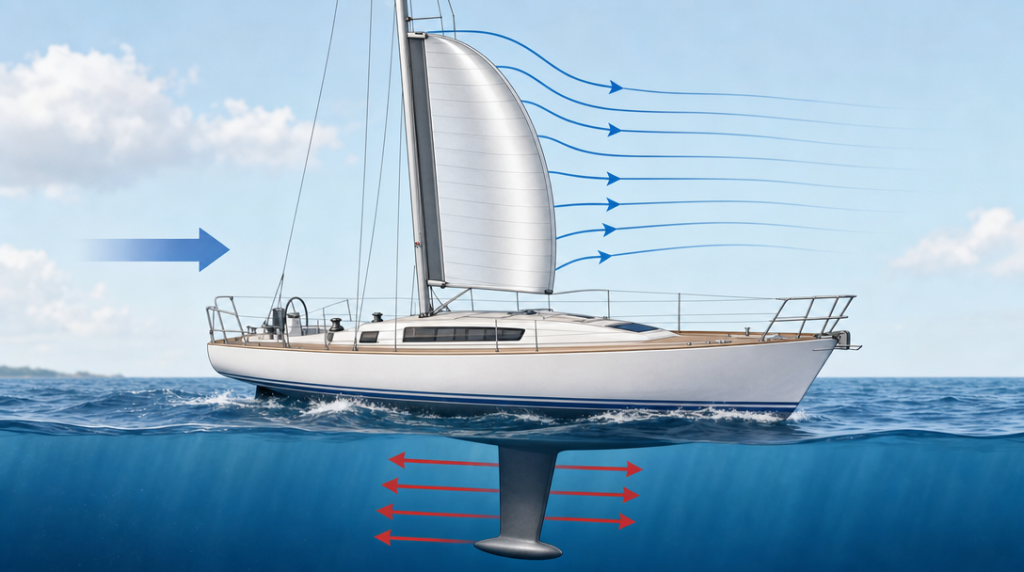
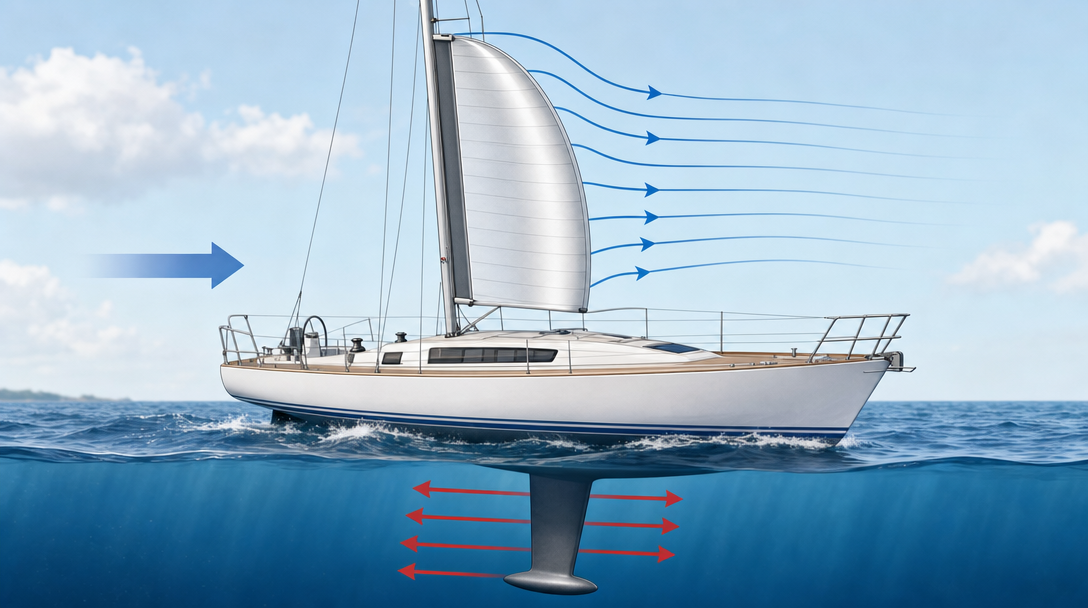
A sail acts as more than just a sheet pushed by the wind from behind. It can be compared to an airplane wing turned sideways: the airflow creates lift, and its direction depends on the shape and angle of the sail to the wind. Therefore, when steering, not only the boat's course is changed, but also the position of the sail.
The sail force has a lateral component. It is counteracted by the heavy keel under the hull: it prevents the boat from drifting sideways, reduces heeling, and maintains forward motion. On this outing, the boat was traveling at approximately 2 knots under the mainsail alone, but after the genoa was tacked, the speed increased to approximately 4–4.2 knots. This observation cannot be considered a guaranteed effect of a single setup: both sails were in operation, and the conditions varied.
The heading sets the boat's direction, the sheet changes the sail's position, and the steering lines allow you to change its camber. These actions are interconnected but not interchangeable.
What parts and gear do you need to know before heading out on the water?
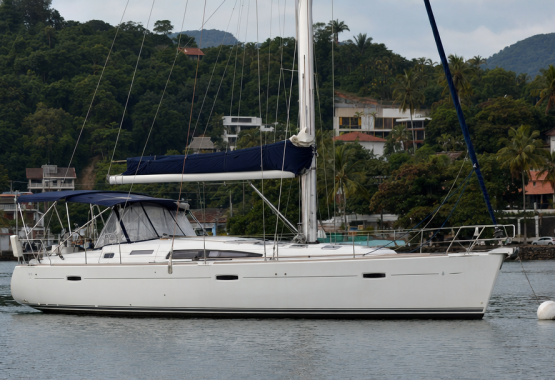
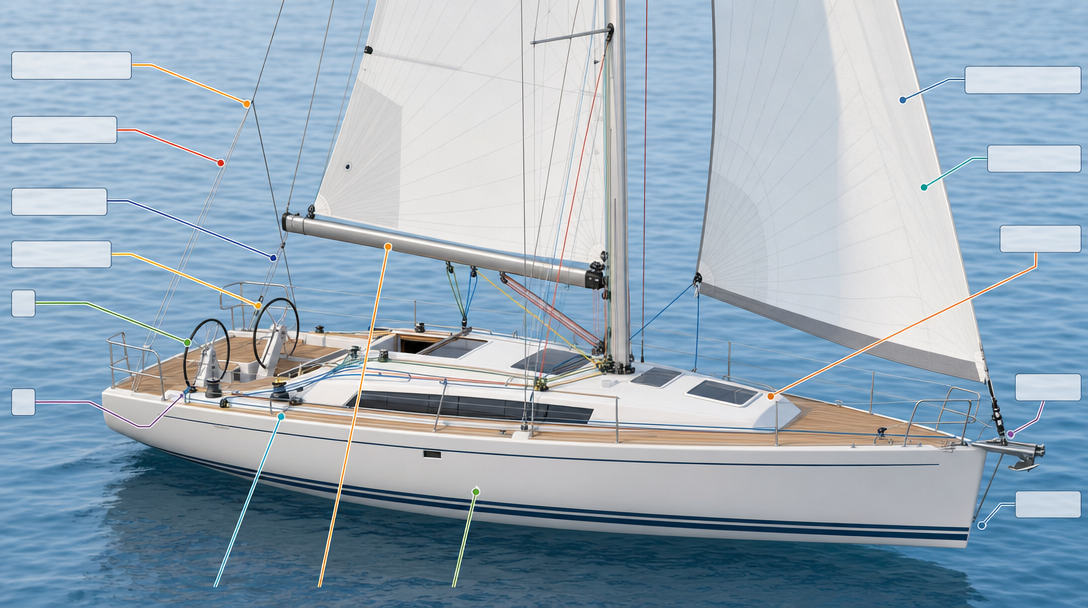
A simple vocabulary will suffice for the first steps. The front of the boat is the bow, the back is the stern; the sides are called port and starboard. The mast holds the sails, and the keel is located under the hull. The mast is held in place by shrouds spread apart by spreaders, as well as by a forestay forward and a backstay aft. All of this is considered standing rigging.
The main sails on this boat are the mainsail and genoa. The mainsail is hoisted along the mast and connected to the boom. The genoa is a large headsail that extends behind the mast; on this boat, it is permanently installed and furled on a roller furler.
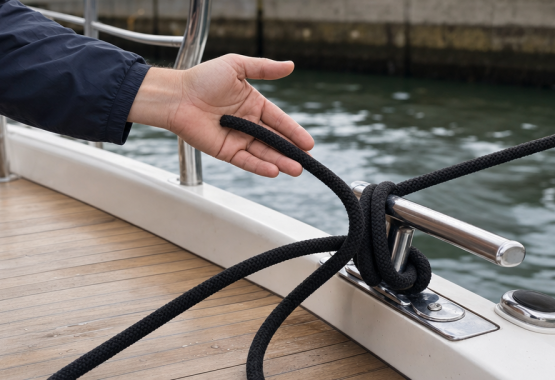
A sailboat's primary rigging is the running rigging. The halyard raises the sail, the sheet controls its position, and the winch helps haul in the loaded sheet. For the mainsail, a mainsheet is used, connected to the boom; for the genoa, sheets are used, running aft through blocks and winches. On other boats, the headsail may be attached to the staysail with stays and then hoisted differently.
- Mainsail halyard — tackle for raising the mainsail.
- Mainsheet — a tackle used to control the boom and the angle of the mainsail.
- Genoa sheets - rigging for adjusting the front sail from different sides.
- Roller furler — a device that allows the genoa to be unfolded and folded.
- Wang Gika and the lower luff pull are additional adjustments to the mainsail shape.
The halyard raises the sail, the sheet changes its position, and the furler unfurls or removes the genoa.
How to raise the mainsail and start sailing
This boat is first motored and turned into the wind. This position allows the mainsail to rise more freely. Before raising, the ties are removed and the sail and rigging are checked to ensure they are not snagged.
- Point the boat into the wind. The sail should be raised in a position where the wind does not fill it immediately.
- Clear the grotto. Remove the ties and check that there are no snagged tackles around.
- Raise the sail up the mast, controlling it from above. You need to make sure that the mainsail moves smoothly and does not catch on anything.
- Remove loose ends of the tackle. Left-behind gear can fall into the water, get caught, or get caught in the propeller and stop the engine.
- After lifting, slightly select the mainsheet. It should allow you to control the boom.
- Then turn off the engine. After this, the boat continues moving under the grotto.
After shutting off the engine, the boat can be slightly heeled off the windward position. If you ease the mainsheet, the boom will move outward; if you heave the sheet, it will move inward. The boom vang keeps the boom lower, and easing it allows the boom to rise and give the mainsail a deeper shape. Before shutting off the engine, check three things: the boat is pointed into the wind, the mainsail is raised without snags, and the loose rigging is stowed.
How to set a course and adjust sails to the wind
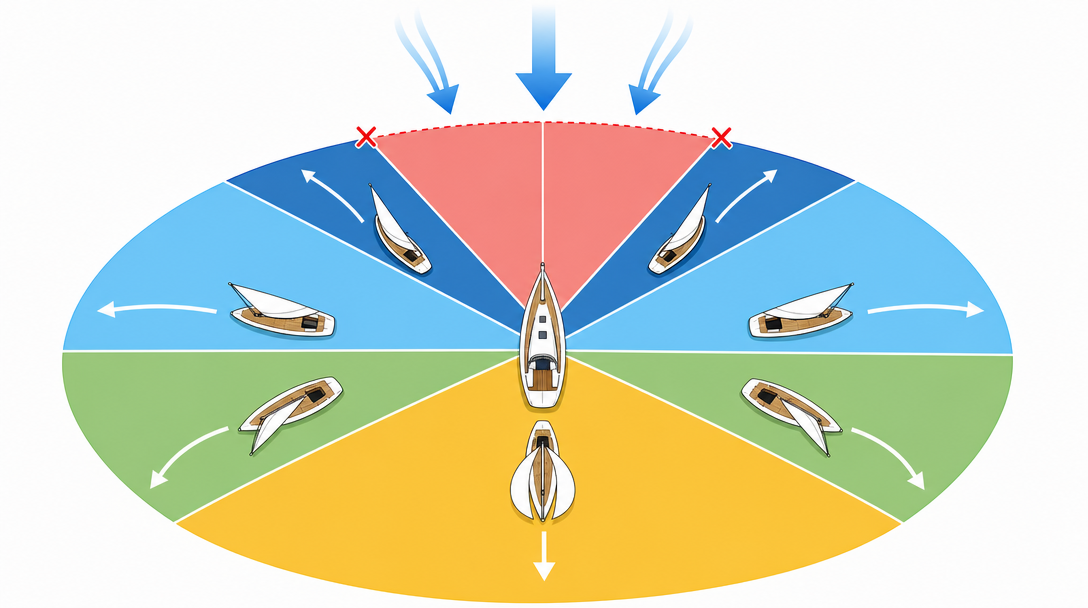
A sailboat can't sail directly into the wind. There's a dead-heading zone ahead of the bow—approximately 45 degrees—where the sails begin to flap and don't work properly. To set a sailboat's course relative to the wind, first determine the direction of the wind and then choose the closest working direction.
Courses from close-hauled to jibe
| Well | Wind position | What's happening to the boat? |
|---|---|---|
| Slow-moving course zone | Straight ahead, about 45° | The sails are flapping, making straight movement impossible. |
| Beydewind | The wind comes from the front and side | The boat is sailing close to the wind |
| Gulfwind | Wind abeam | The boat is sailing at approximately a right angle to the wind. |
| Backstay | The wind comes through the stern corner | The sails are filled from the rear side |
| Fordewind | Wind from the stern | The boat is sailing straight or almost straight downwind |
Courses exist on both sides of the boat. If the wind is coming from the starboard side, it's a starboard tack; if from the port, it's a port tack. Close-hauled, the sails are trimmed, and when switching to a beam reach, the mainsheet and genoa working sheet are gradually eased out. On this boat, the mainsail's position is further adjusted by the mainsheet track, the boom vang, and the foot vang.
How to change the sail shape to suit the conditions
On a beam reach, the sails are eased out to a light flutter, then hauled back slightly. On one outing, in a wind of about 6-7 knots, the boat was traveling at 4.5-4.6 knots. With the mainsail eased out excessively, the speed dropped from approximately 4.8 to 4.6-4.7 knots, and after a slight adjustment, it returned to 4.7-4.8 knots. The wind also changed during this time, so the result cannot be attributed to the sheet movement alone.
Sail tuning is based on testing: assess the sail shape, slightly adjust the rig, and observe the results. If the mainsail begins to flap noticeably or stops filling, the sheet is pulled in slightly. If the wind increases, the lower part of the mainsail can be straightened by pulling the foot. With each course change, check which side is now in effect, where the boom is, and how much the sails are bulged.
How to reduce the mainsail area and control sails downwind
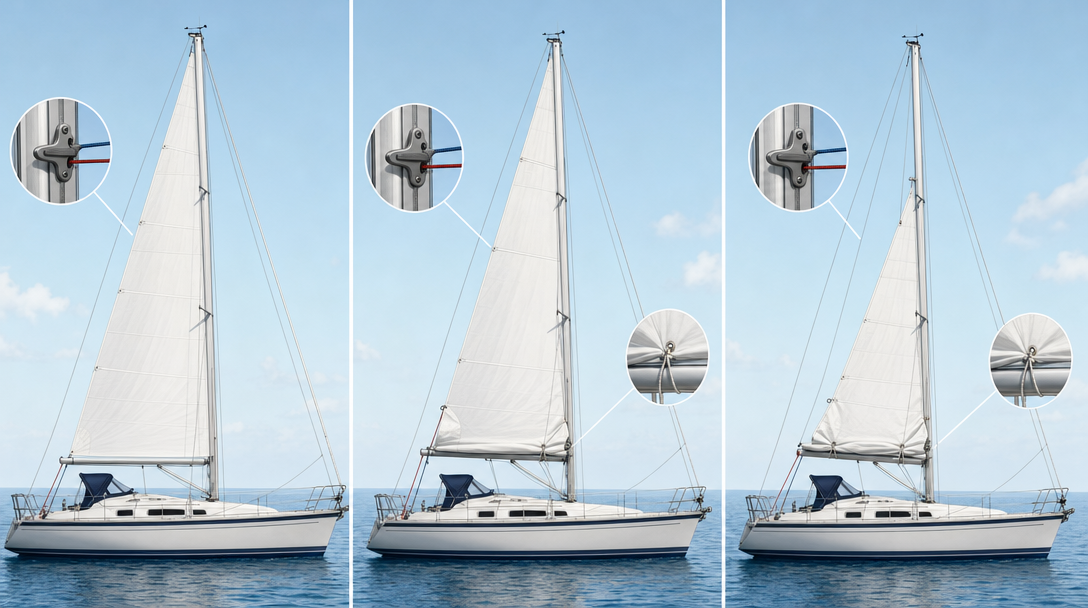
When the wind picks up, the mainsail can become too powerful. In this sequence, the sail area is reduced by reefing: the mainsail is lowered to the first or second reefing point, the halyard and reefing gear are secured, and then the halyard is tightened again. On this boat, this action reduces the sail area, wind impact, heel, and load on the equipment.
- Loosen the mainsail halyard and lower the sail to the first point of corrugation.
- Hook the ring onto the horn for knurling and raise the mainsail again.
- Tighten the first reef end, going back, then secure the ties.
- With even greater wind strength Lower the mainsail to the second point, secure it and tighten the halyard again.
On a broad reach, the wind comes through the stern corner. On this outing, the speed on this course dropped to about 4 knots, and the waves coming from the stern corner increased the yawing and pitching. When sailing almost downwind, the mainsail can cover the genoa. Sometimes a "butterfly" position is used, with the mainsail and genoa on opposite sides, and the boom held in place by a guy line or a safety. Another option mentioned is a spinnaker pole, which moves the headsail further outboard.
Before changing the configuration, check to see if the mainsail area has become excessive, that the boom is controlled, and that the headsail continues to fill. The specific choice between a mainsail and a genoa depends on the sail sizes on the boat.
How to Perform a Downwind Turn and a Gybe Turn
If the desired direction is directly into the wind, the boat zigzags toward it. A downwind turn brings the bow into the wind's direction and changes tack. Before the maneuver, check that the genoa's free, or lazy, sheet can pass without snagging.
- Prepare to turn through the wind. Make sure the lazy sheet is clear and give the command.
- Guide the boat's bow through the wind. The mainsail will move to the other side when the boat crosses the wind direction.
- Translate Genoa. The sail moves forward, the previous working sheet becomes lazy, and the other side becomes working.
- To gybe Change direction with the wind from behind and control the mainsail and boom with the mainsheet.
A gybe is distinguished by the fact that the wind is on the opposite side of the boat when sailing downwind. At this point, the boom can suddenly shift to the other side; this unintentional movement requires control with the mainsheet. The procedure depends on the specific boat and its rig.
What to keep in mind when controlling a sailboat
Basic sailboat control involves adjusting the course relative to the wind, the boom position, and the sail shape. This sequence begins with the mainsail upwind, then the genoa is engaged, sheets are adjusted on the working course, and as the wind increases, the mainsail area is reduced by reefing.
Before each course or setting change, check:
- where the wind comes from and what course is chosen;
- what sail and what rig are working now;
- how the sail shape changes after the sheet is moved;
- where the boom will move and whether the mainsail needs to be reduced.
These questions help to differentiate between a close-hauled sail, a beam reach, a broad reach, and a jibe, to understand the purpose of halyards and sheets, and to distinguish a turn through the wind from a jibe.