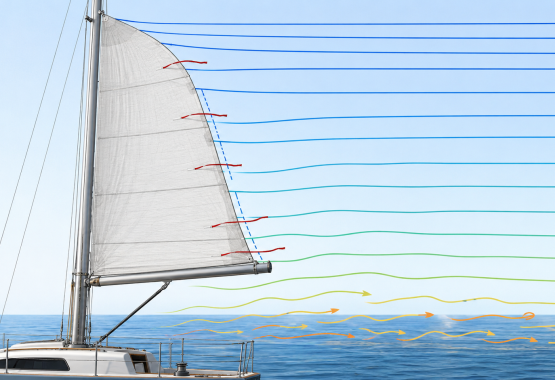
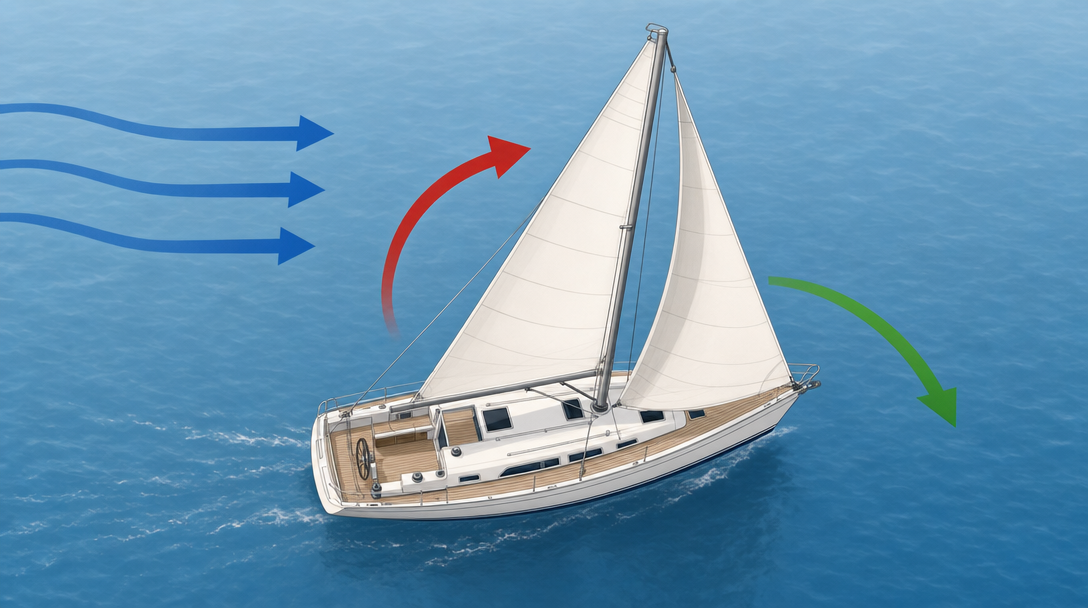
If you leave only the main sail on the boat, with the wind on the port side, it gradually turns its bow into the wind. If you remove the main sail and open one jib, the boat, on the contrary, bears away until it's heading directly downwind. At first glance, this seems paradoxical: why doesn't one sail propel the boat forward on its own?
The answer has to do with balance. The mainsail brings the boat into the wind, while the headsail bears it away. Movement occurs between these two influences. Therefore, the question of "how to choose a sail based on wind strength" cannot be separated from wind direction, sail area, and the ability to trim or shorten it in time.
Why does a boat move due to the balance of the mainsail and headsail?
MainsailThe mainsail, or mainsail, is located on the mast and boom aft. In the situation described, with the wind from the port side, the pressure on one mainsail causes the boat to gradually turn into the wind. The turn continues until the wind is directly in front of the bow; the boat can no longer move beyond that.
The headsail in this design is called jib or headsailIf you leave only this one open, the boat begins to turn into the wind. With the same wind on the port side, it bears away until it's moving directly into the wind.
This creates two opposing effects: the main sail brings the boat into the wind, while the jib bears it away. When both sails work together, their effects are balanced enough to propel the boat forward. Therefore, the mainsail cannot be considered "main" simply because the word "main" appears in its English name: the connection between the main and headsails is crucial.
How to read wind angles and avoid confusion over headsail names
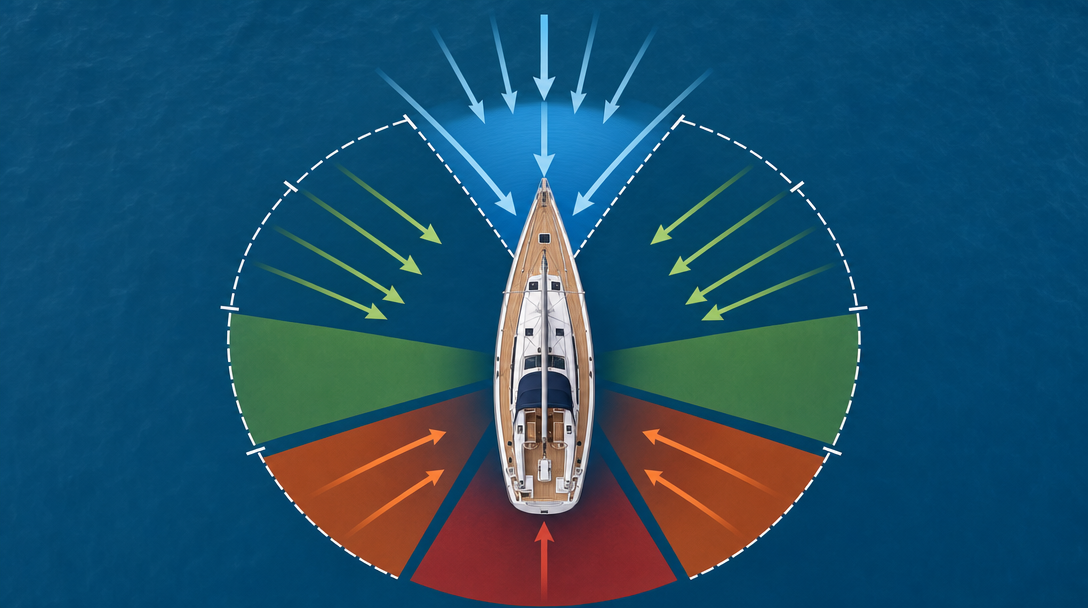
For the working reference frame, 0° is the wind directly at the bow. Around 30° is the range where the boat doesn't sail. At 90°, the wind blows directly at the side, and 180° means the wind is at the stern.
Angles are calculated separately for the port and starboard sides. Therefore, instead of a single scale up to 270°, this scheme refers to a range from 0° to 180°. port side — to the left side — and from 0° to 180° starboard — starboard. To select a sail, it's important to first understand not only the sail size but also which direction the wind is coming from relative to the boat.
There's a terminological caveat regarding the names of headsails. In this explanation, the outer headsail is called a jib or headsail, the inner headsail is called a staysail, and the extended headsail is called a genoa. In Russian-language sailing, the headsail is often called a staysail, although this word can refer to both the inner sail and the staysail. Therefore, the more important issue here is not the dispute over terminology, but rather understanding the position and purpose of the sail.
How to choose a sail based on wind strength and reduce its area
When the wind increases, the sail area is reduced. This can be achieved by reefing—a special system that allows the sail to retain a suitable rig but reduces the effective area. In this scheme, each reef reduces the effective area by approximately 25 percent.
- the first reef leaves about 75% of the original area;
- the second one is about 50%;
- the third is about 25%.
Reefing is intended for both mainsails and jib sails. However, when conditions change significantly, another approach is used: switching to a smaller sail. The general sequence for selecting sails based on wind strength is as follows:
- for the lightest winds, large sails are used - gennakers, spinnakers and other similar options;
- then Code 0 is set, designed for a lighter wind than the genoa;
- after it the genoa is used;
- Next comes the standard sail rig with the usual main and jib;
- with further strengthening, a smaller staysail is selected;
- When the wind is around 35-40 knots, a storm staysail is used.
The last guideline shouldn't be taken as a universal limit for any boat: it's a matter of the given sequence and approximate value. In practical selection, first compare the wind direction and strength with the available sails on the boat, and then check whether the sail area can be reduced by reefing or whether a smaller sail is needed.
What systems help to remove and reef sails?
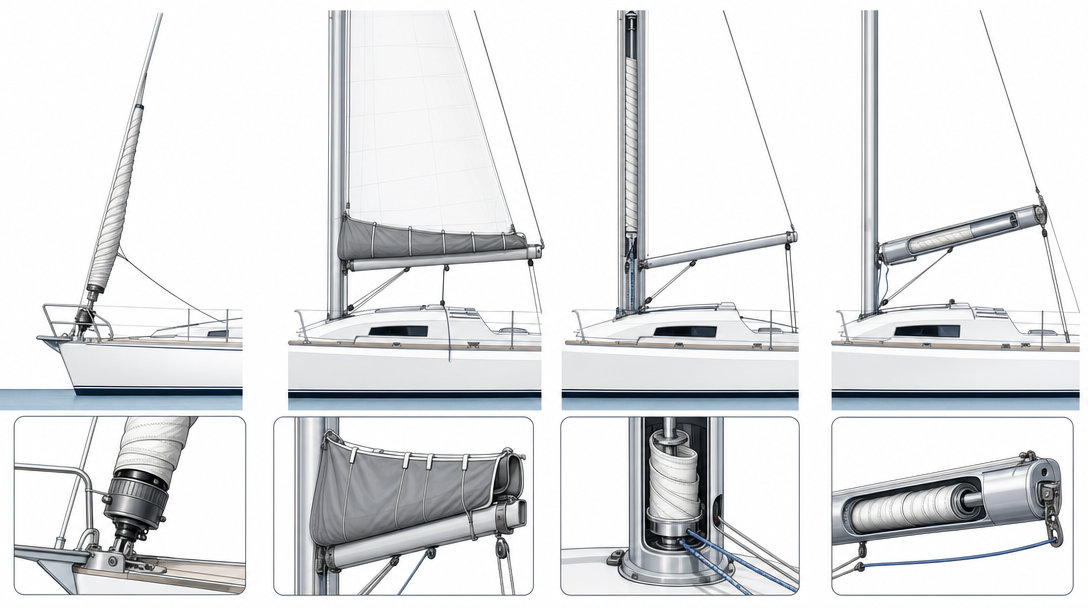
How to remove the headsail
The headsail is usually mounted on a system furlingWhen the sheets are released, it is unwound from the reel and is used for cleaning. furling line, which rotates the mechanism in the opposite direction and winds the sail again.
This system can be mechanical, with the drum being rotated by a line, electric (with an electric motor), or hydraulic (with a hydraulic motor). Electric and hydraulic options complement the mechanical system; hydraulics are typically used on larger boats.
An older system with hooks on the headsail is also described for storm sails. The sail is raised using these hooks, but this option is considered inconvenient for everyday use. Therefore, when choosing a rig, it's important to understand in advance what mechanism is installed on the boat and how it lowers the headsail.
What systems are used for mainsail?
One of the common systems is lazy bagWhen the halyard is opened, the main sail is lowered into a special bag. There's also a furling mechanism inside the mast. This is convenient for everyday use, but if the mechanism gets jammed inside the mast, the sail cannot be stowed, leaving too much sail area on the boat.
In an older system, the sail is attached to the boom via grommets. There is also a V-shaped boom, in which the lowered sail is folded without a separate bag. Another option is furling boom: the sail is twisted into the boom.
The furling boom has a specific limitation: the boom must be positioned so the sail can furl. If it's raised or lowered at the wrong angle, the furling will not work. Therefore, before furling, it's important to know not only the system's name but also the required boom position, as well as the proper functioning of the mechanism.
What's the difference between a genoa, spinnaker, gennaker, and Code 0?
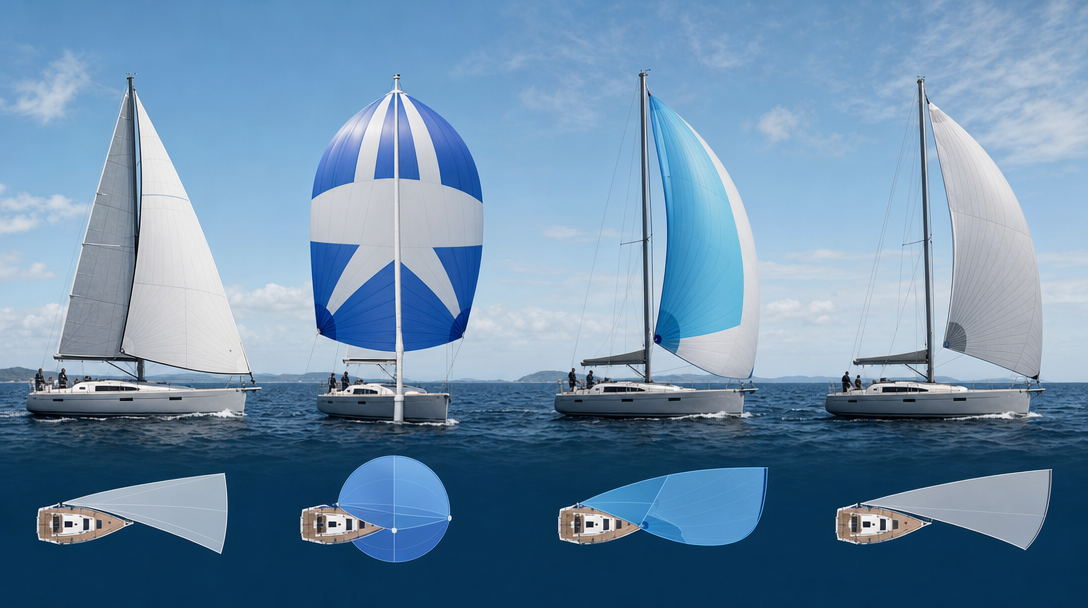
A genoa is a large, asymmetrical headsail, typically about 120% in area compared to a standard jib. It extends behind the shrouds and mast and serves as a powerful hauling sail. A smaller version can be installed as a second headsail when used with a genoa.
A spinnaker, or kite, is designed for downwinds. Setting it requires several manipulations of the tack and pole, so using this sail requires a crew. A special sock is used for a symmetrical spinnaker: the sail is gathered into it and then removed.
A gennaker is also known as an asymmetric spinnaker. It is set in the outermost forward position and is usually furled. Unlike a spinnaker, it can be furled using this system; the sail is attached to a strong cord. This sail is designed for lighter winds than a genoa and allows for sailing at angles of around 70° or slightly sharper—this is a guideline, not a universal value.
Code 0 — another headsail for lighter winds. It is mounted forward and may also have a furling system that furls it through a loop and a central axis. The names Code 0, Code 25, Code 125, and Code 625 are used as an example of standardization for racing sails, replacing a variety of controversial terms.
After use, large headsails are stowed on deck or otherwise collected in the designated manner. The Code 0, gennaker, and spinnaker are not left in their designated position before furling a standard jib; furling the headsail can cause the Code 0 to become tangled in the furler. This limitation is specific to the system described and the experience gained from using it, so the stowage procedure should be considered before furling the headsail.
What to check before choosing and removing a sail
The sail is selected based on the wind direction and strength, but the decision doesn't end with the sail name. It also includes the balance between the mainsail and headsail, the available area, the number of reefs, and the installed hauling system. As the wind increases, the area is reduced by approximately a quarter with each reef or a smaller sail is selected from the available options.
Before changing or cleaning, check yourself with four questions:
- From which side—port side or starboard—does the wind come and at what angle to the boat?
- How will the chosen sail change the balance between main and jib?
- Is it possible to reduce its area by knurling, and is the furling mechanism working properly?
- Is the Code 0, gennaker or spinnaker removed before furling the headsail and the boom set in the correct position if using a furling boom?