The boat is sailing close to the wind. The sheets are completely slack, the sail is flapping, and the airfoil is barely working. You begin to pull in the sheet—the sail fills with wind, and the pull increases. It seems logical to pull further, but at some point the boat begins to heel more, the drag increases, and the speed drops. Why is this happening?
The answer lies in aerodynamics. Adjusting the sail's angle of attack reveals the very boundary where useful thrust gives way to flow separation. Let's figure out at what point increasing the angle of attack stops helping the boat and how to detect an approaching stall by the behavior of the sail's sailors.
How sheeting changes the sail's angle of attack
A sail's angle of attack is the angle between the direction of the oncoming airflow and the chord. The chord itself is an imaginary straight line connecting the leading and trailing edges. It allows for precise alignment of the profile's position with the wind direction.
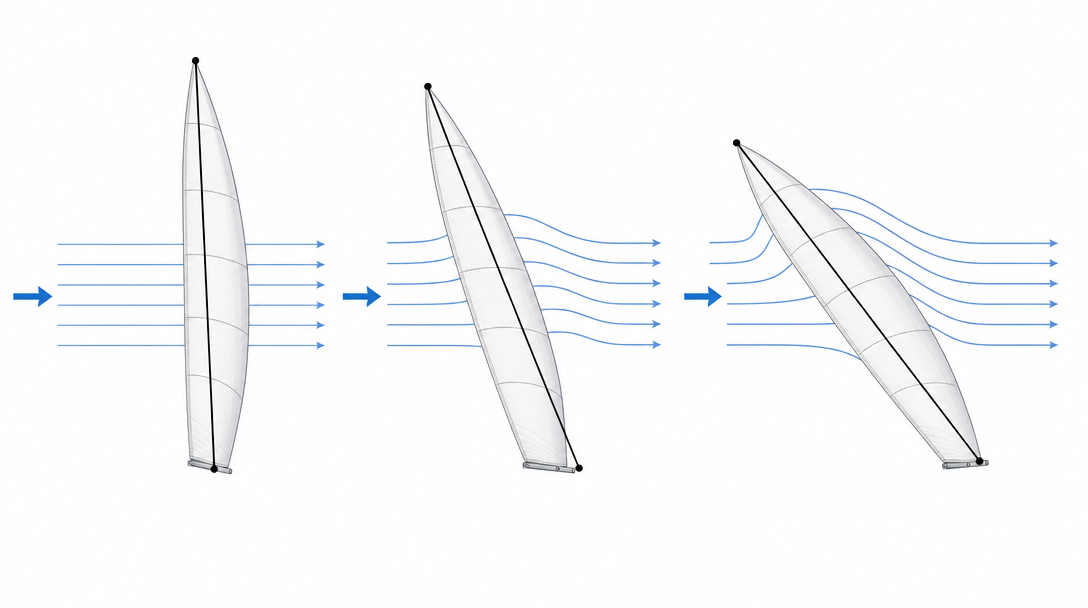
When the sail is fully trimmed and flapping, its chord becomes roughly parallel to the air velocity vector. The angle between them is approximately 0°, so virtually no lift is generated.
As the sheet is hauled in, the chord turns toward the oncoming airflow, increasing the angle of attack. If we imagine a boat sailing at approximately 45° to the wind, a partially hauled sail will correspond to an angle of about 20°, and a fully hauled sail will correspond to an angle of about 40°.
These figures merely illustrate the general mechanics. In practice, it's important to distinguish between the physical sheet tension and the aerodynamic effect: a higher angle of attack doesn't always mean better thrust.
Why does increasing angle of attack initially increase lift?
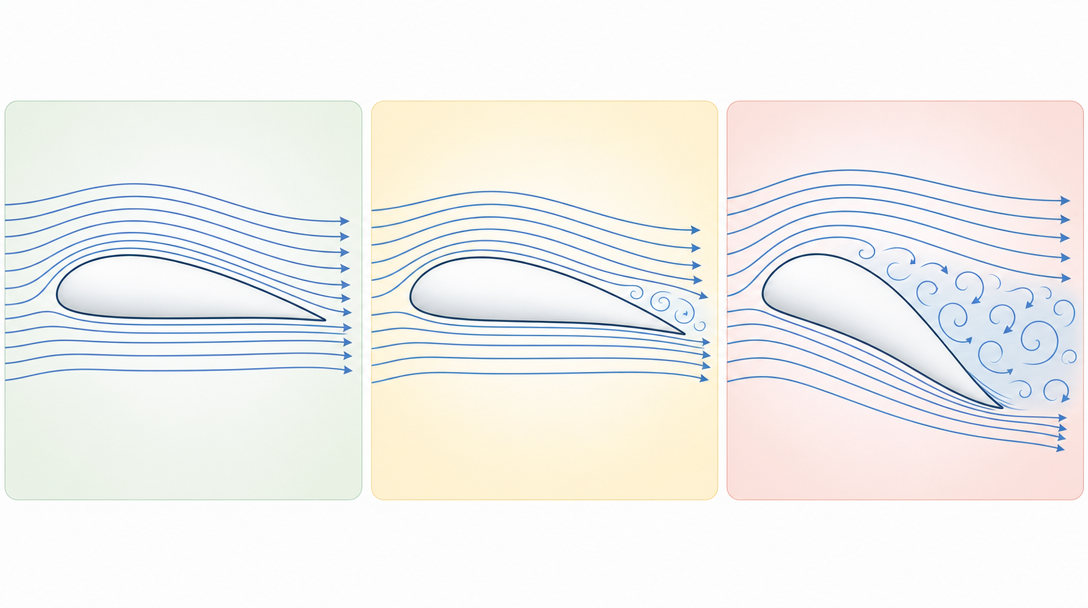
The sail's aerodynamics begin to work even with a slight angle of the profile toward the wind. At a near-zero angle, the streamlines above and below the profile converge equally. A low-pressure region on one side is compensated by a similar region on the other, so the sail's total lift remains minimal.
With a moderate increase in the angle of attack, the picture changes. The streamlines on the leeward side become closer together, while those on the windward side are further apart. This creates a pressure difference, which generates lift.
As you continue to pull in the sheet, the flow lines at the leading edge become even closer together, and the gap between them widens on the aft side. The pressure differential increases, adding to the sail's thrust.
This is why a flaring sail comes to life after the sheet is tensioned. However, the beneficial effect is limited: with the angle of attack, drag inevitably increases, and the airflow risks losing contact with the profile shape.
The next step in tuning is to monitor whether the flow remains attached all the way to the leech, or whether it is already starting to break away at the aft end of the sail.
Where does flow separation begin and why does the sail stall?
The attached flow on the sail smoothly flows around the airfoil to the trailing edge and only there does it straighten out. If the flow lines cease to adhere to the surface and diverge, the flow separates from the sail. This process most often begins in the trailing third of the airfoil.
Widely spaced streamlines indicate a drop in wind speed and a localized increase in pressure. This pressure begins to counteract the reduced pressure in the forward part of the airfoil, weakening the overall thrust. However, a slight lift at the very trailing edge is acceptable: the effective luff action offsets the losses in the aft section.
If the sheet is pulled, the separation zone rapidly increases. Effective flow is maintained only in a narrow section near the mast or forestay. Drag increases sharply, and thrust drops to practically zero—this condition is called stalling.
Separation can also occur closer to the leading edge, in the form of so-called laminar bubbles. If the sail is over-trimmed, such a bubble forms on the leeward side, and if it's under-trimmed, it forms on the windward side. In reality, these separation zones are quite small, although they are often drawn larger in training diagrams for clarity.
A localized separation in itself doesn't necessarily mean a complete stall. The problem arises when the flow ceases to be contained over a significant area of the sail, and the fins begin to flap chaotically, signaling a breakdown in the working flow.
What does the leech indicator show?
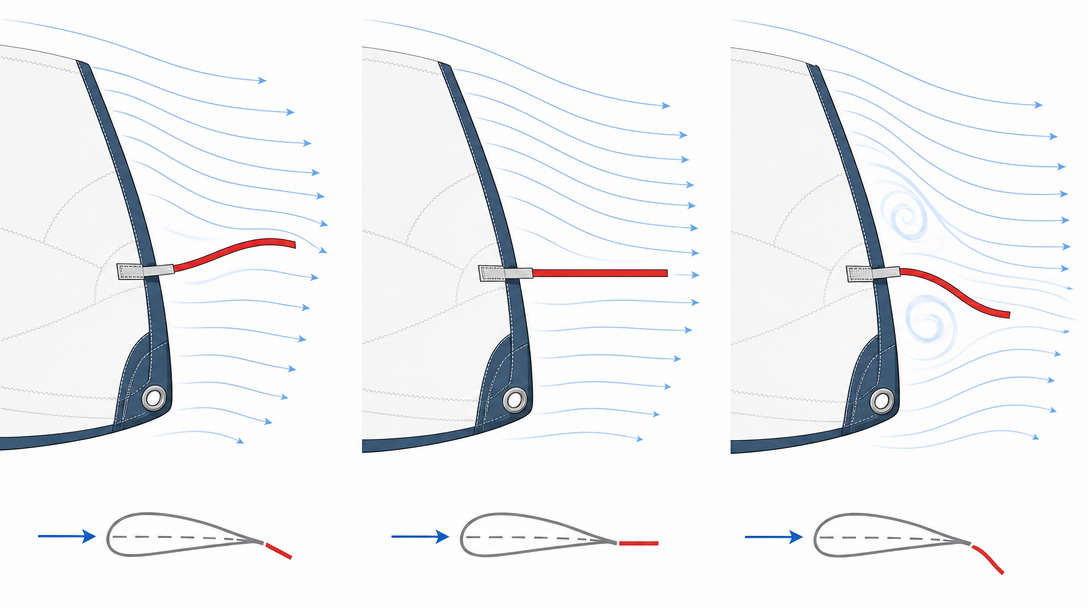
The leech teller is the primary tool for controlling the aft wind separation. If the leech is not overtightened and the wind remains attached, the teller will consistently flutter back, downwind.
A forward deflection of the leech usually indicates that the sheet is undertightened or the leech is too closed. The sail's shape in this area prevents wind from flowing freely off the edge, and the trim needs to be adjusted.
A slight break at the trailing edge looks different: the streamer flies straight back most of the time, but occasionally veers to the leeward side. For normal cruising, it's considered normal for the spar to tuck behind the sail about a third of the time.
But if the rear indicator constantly wobbles on the downwind side, this is a sure sign of a strong liftoff and a possible stall. When evaluating the settings, focus on a stable picture, not on isolated jerks of the indicator.
How to adjust a sail using sorcerers
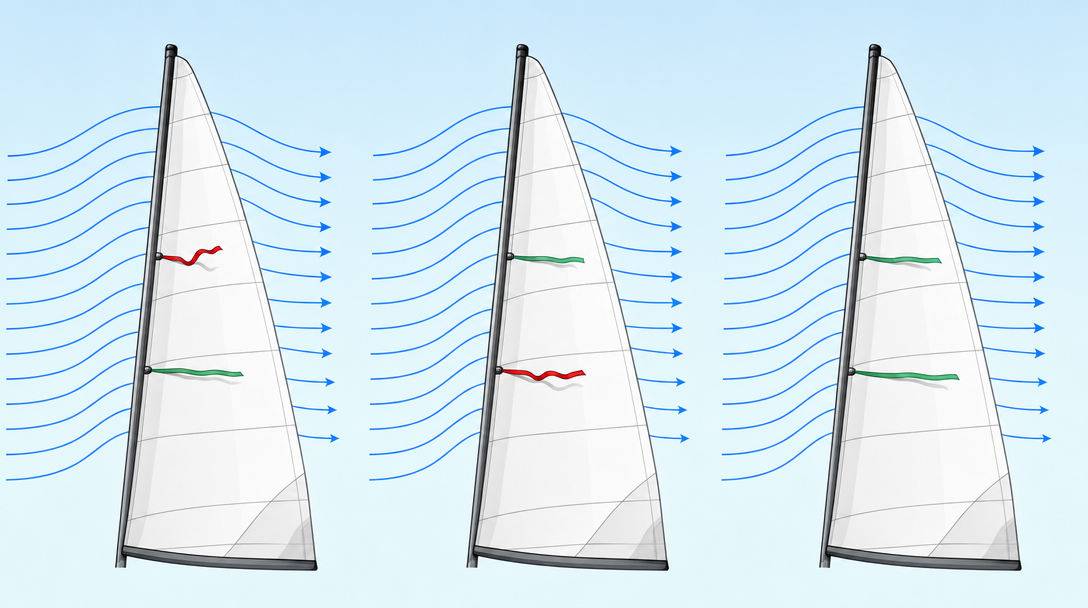
The tell-tale switches on the sail itself allow you to control the flow on both sides of the profile. When perfectly adjusted, both tell-tale switches flutter smoothly backward. Erratic movement or the separation of one of the strips from the fabric indicates a disruption of the flow on that side.
Typically, spar cleats are not attached directly to the mast or forestay, but rather set back about a third of the sail's length from the luff. This is because laminar flow bubbles form not at the very edge, but slightly further downstream.
| Watching the sorcerers | What does it mean? | Correction |
|---|---|---|
| The right wizard moves erratically, the left one flutters back | Flow separation on the side of the chaotic sorcerer | Bring the boat into the wind or ease the sheet |
| The left wizard moves erratically, the right one flutters back | Flow separation on the side of the chaotic sorcerer | To fall away or to heave in |
| Both sorcerers are fluttering back | The entire stream is connected | The setup is generally correct. |
This diagnostic helps quickly make decisions about changing course or sheet tension. The key is to clearly identify which telltale is drifting away from the surface and apply adjustments only to that side.
The erratic behavior of the telltale is caused by the circulating air in the area of the separation bubble pushing the ribbon outward. Meanwhile, the telltale on the smooth side remains flat on the fabric. Correct sail tuning using the telltale is achieved when both ribbons are pointing smoothly aft.
What reference point should I use when setting up a sail?
Although hauling in the sheet increases the angle of attack and thrust, this process has a hard limit. At excessive angles, drag increases sharply, the flow separates, and the sail stalls. Therefore, the primary focus should not be on maximum sheet tension, but on maintaining the attached flow on both sides of the profile.
Make sure the tell-tale signs are fluttering evenly back, and distinguish between an acceptable short-term leech curl and a constant, chaotic flutter. Knowing how to read these simple tell-tale signs allows you to spot the stall threshold early and transform the simple angle-of-attack geometry into effective sail performance.