In 1910, the sailing ship Prussia collided with a small steamship. The steamship's captain misjudged its speed, believing that a sailing vessel couldn't travel that fast. The Prussia, launched in 1902 and known as the world's largest square-rigged sailing ship, was damaged and eventually sank.
Her speed was 16 knots—about 29 km/h. To a land-based observer, this doesn't seem impressive, but small cruising yachts often reach only 6–8 knots. What determines a vessel's speed? Why can a yacht sail against the wind, or even faster, and why is it held at anchor by more than just the anchor? The answer lies in the hull, sail, keel, chain, and other elements working together.
Why does hull length limit a ship's speed?
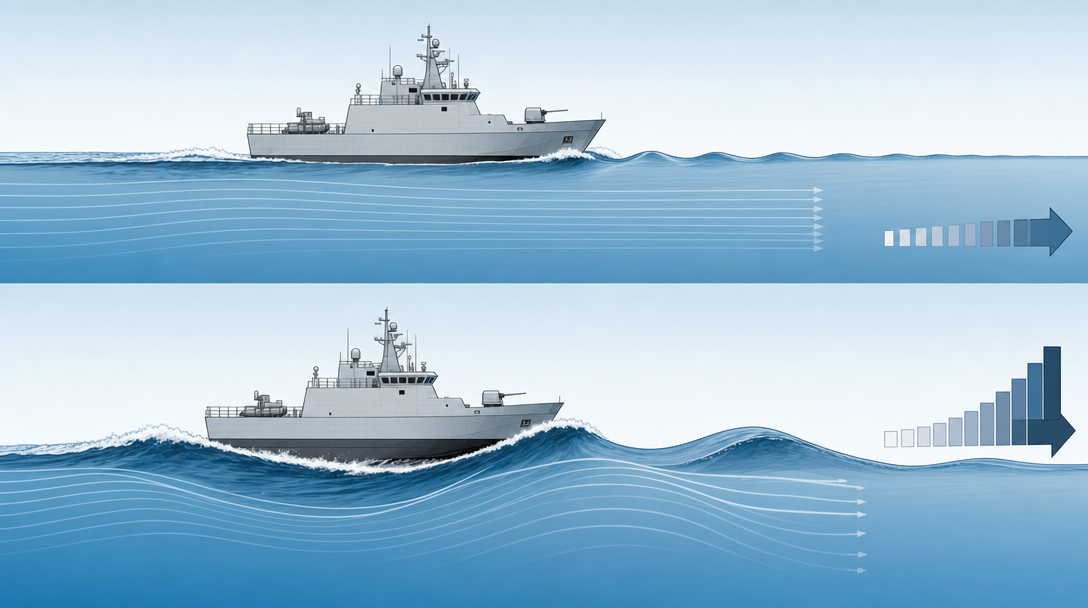
A boat's speed depends on more than just engine power or wind strength. As it moves, the hull creates a wave in front of it. The faster the boat goes, the longer this wave becomes, and the water has to resist the hull's movement more and more.
As long as the wave is noticeably smaller than the hull, the vessel moves relatively smoothly. But at a certain ratio of wave to hull length, the bow begins to rise onto the crest, and then the vessel must continually overcome increasing resistance. This is where the "drag" problem arises. wave crisis of a vessel: a small increase in speed requires a very large increase in power.
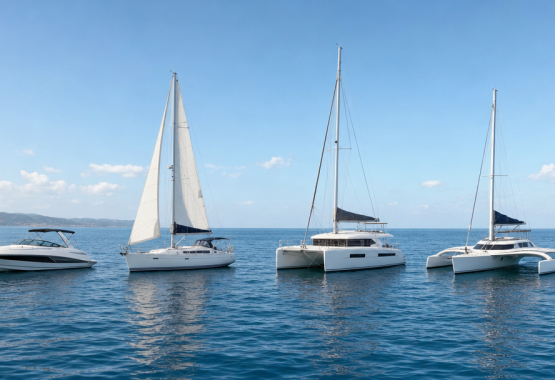
A long hull reaches this limit at a higher speed. Therefore, length does influence top speed, but it doesn't mean that any long vessel is automatically faster than any short one: both water resistance and hull shape are important. From this perspective, the 16 knots of the Prussia and the 6-8 knots of a small cruising yacht can't be compared solely by engine size or wind strength.
The wave limit can be overcome by planing—a mode in which the vessel appears to glide across the surface of the water. However, this typically requires disproportionately more power. Therefore, when assessing a vessel's speed, it's useful to look not at the usual land-based comparisons, but at the hull length and the wave it creates.
How the hull recovers the ship from a list
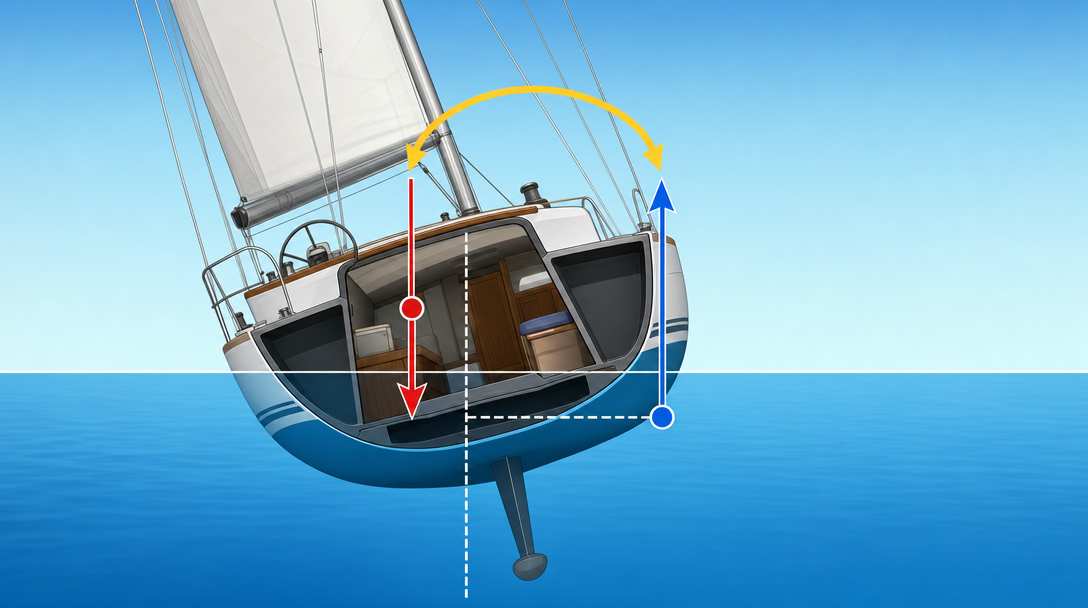
A tall cruise ship can rise to over 70 meters, while its underwater section is often less than 10 meters. The simple explanation of "all the heavy parts are below" is insufficient for such stability: engines, fuel reserves, and ballast do affect the center of gravity, but the center of gravity is still quite high.
There are two primary forces acting on a vessel: gravity and the buoyant force of the water. The buoyant force can be thought of as being exerted simultaneously at a single point—the center of buoyancy. In a calm position, this diagram may seem counterintuitive, especially if the center of buoyancy is below the center of gravity.
When the boat heels, the center of gravity remains roughly the same, but the center of buoyancy shifts toward the submerged portion of the hull. The shape of the bottom is crucial here: more of the hull is in the water on the heeled side, increasing the buoyancy force there. Gravity and buoyancy form a pair that rotates the boat against the heel and returns it to an upright position.
This is how a vessel's stability works—the ability to maintain balance and recover from an inclination. It has a limit: after a certain angle, the hull can still capsize. For this boat, an angle of approximately 120 degrees was cited; this is a boat-specific characteristic, not a universal standard for yachts. At this inclination, the sail may sink, but the hull is capable of returning to its normal position. This shouldn't be tested in practice. Hatches should be kept closed.
How a sail and keel allow you to sail against the wind
The sail as a wing and the role of the keel
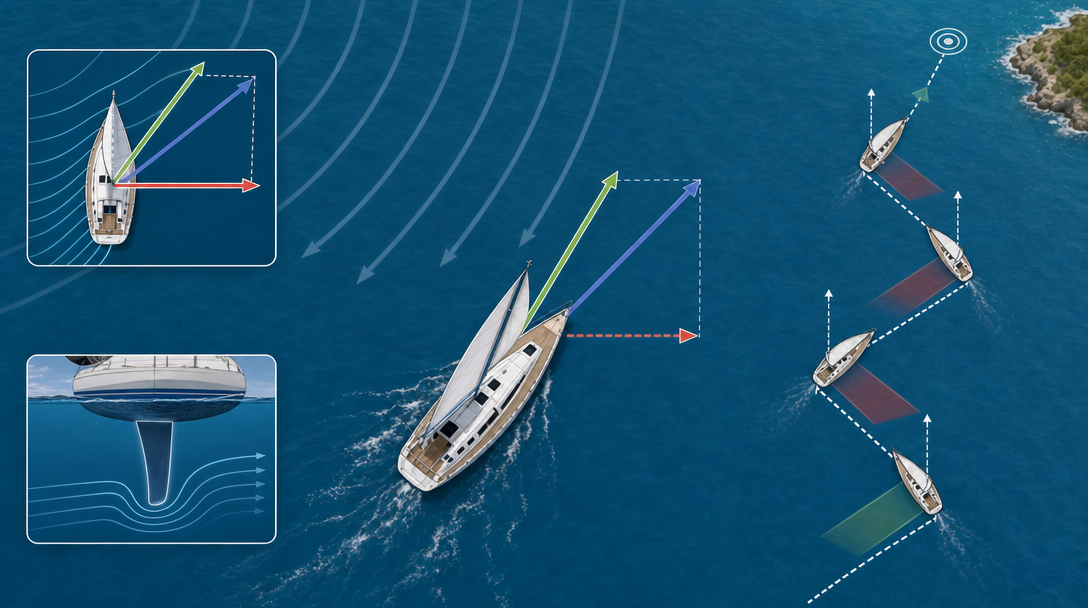
A sailboat can't sail directly into the wind. But that doesn't mean the wind can only move the boat strictly in its direction. In a crosswind, the sail can be adjusted to act like an airplane wing.
A low pressure is created on one side of the sail, and a high pressure on the other. This creates lift, directed not upward, like an airplane wing, but horizontally. It has a forward component, which propels the boat, and a sideways component, which tends to cause drift.
This is where the role of a boat's keel comes into play. A submerged keel counteracts lateral movement and helps convert the sail's action into movement in the desired direction. In a simplified model, the sail creates force in the airflow, while the keel resists drift in the water. This allows the boat to sail not only downwind, but also at an angle to it.
When the wind blows from the side, the effective lift component is reduced, but it may still be sufficient for forward movement. However, the direction of the wind, movement, and lateral drift do not coincide: the sail does not push the boat exclusively from behind.
Tacking and speed above the wind
If the wind blows directly in your face, the boat changes course and moves in a zigzag pattern. At each tack, the sail again creates lift, and its forward component moves the boat toward the target at an angle. This method of movement is called tacking.
- The boat is sailing at an angle to the headwind.
- At the selected site, the sail and keel create forward movement, counteracting lateral drift.
- After changing tack, the boat continues to approach the target from the other side.
The distance traveled becomes longer, but tacking can result in greater final speed toward the target. This is because, in a crosswind, the oncoming airflow doesn't disappear during acceleration. On the contrary, the lift can increase until it is balanced by drag.
This is why racing yachts are capable of moving faster than the wind, although their energy is still derived from the wind flow. On a downwind course, the relative wind flow weakens during acceleration, but it remains the same during a crosswind. This is why moving faster than the wind is possible for some yachts, but not a characteristic of every boat in any wind.
The quality of the sail's flow is monitored by the presence of "wizards"—bright threads. When they are aligned, the flow is smoother and the wind energy is used more efficiently. Rotor sails represent a separate design, but the classic wing sail model already explains both paradoxes: moving against the wind and the ability to exceed its speed.
Why is it not only the anchor that holds a yacht in place?
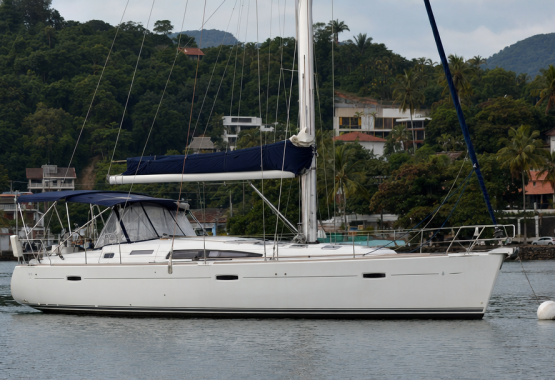
For a small boat, the anchor seems like the primary holding element: it's lowered overboard and secured to the bottom. But as the vessel grows, the heavy anchor chain becomes increasingly prominent in the system.
At anchor, several dozen meters of chain are lowered to the bottom. It rests on the bottom, acting as a weight and creating friction that counteracts wind, current, and other forces attempting to move the vessel. The principle of how an anchor and anchor chain work can be summarized as follows: the anchor holds the chain, and the chain largely holds the yacht.
Theoretically, a chain can hold a vessel without an anchor, but then it's difficult to secure it to the bottom. Therefore, the anchor remains part of the overall system: it secures the chain, and its weight and friction help keep the vessel in place.
How a steel casing is protected from corrosion
A steel hull is constantly exposed to water, and paint serves as the first barrier between the metal and this aggressive environment. However, the coating can wear off, crack, and peel, so paint alone is insufficient to fully explain how metal ships last for years.
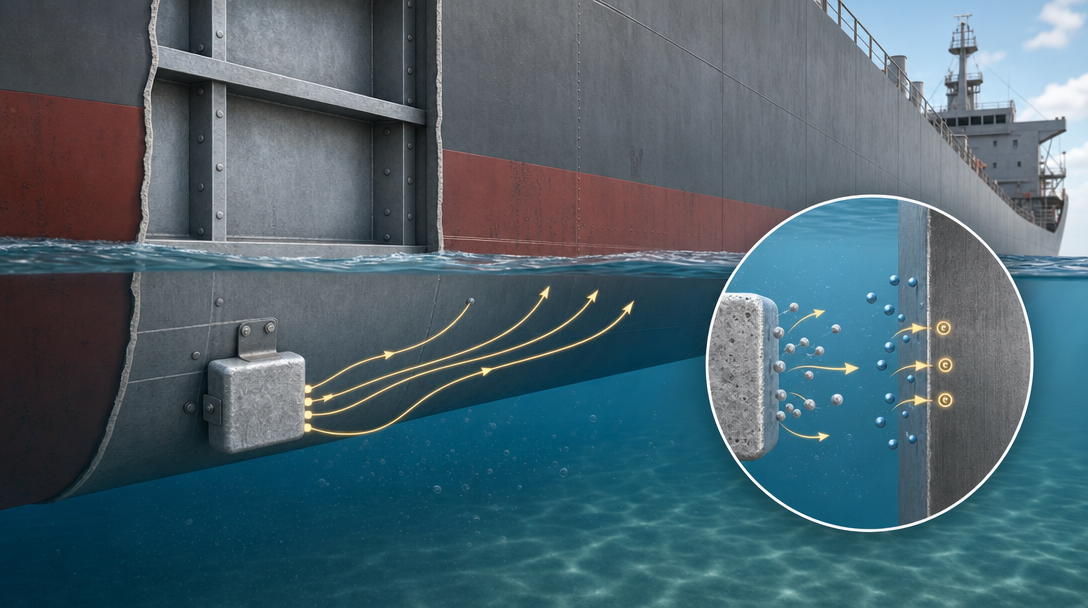
Cathodic protection is also used. Bars, usually made of zinc, are attached to the steel body. When different metals are connected directly or through a conductor, a flow of electrons occurs between them: in this system, electrons flow from the zinc to the iron.
From a simplified electrochemical model, corrosion is associated with the metal losing electrons and then participating in further reactions on the surface. During cathodic protection, oxidation is transferred to the zinc element. The zinc gradually degrades, and the iron body becomes the cathode and is better preserved.
That is why such an element is called sacrificial anode: it absorbs destruction, protecting the larger metal structure. The system can be compared to a battery, where the casing and zinc bar form a linked electrochemical pair. However, the paint and the anode perform different functions and complement each other; while the anode is consumed, its protective effect is not indefinite.
What physics explains about the design of a boat
The design of a vessel unfolds through a system of interacting forces. The hull creates waves and sets the speed limit, its shape maintains stability, the sail harnesses lift, and the keel helps channel that lift into propulsion instead of sideways drift. At anchor, the anchor secures the chain, and the chain, through its weight and friction, holds the yacht in place. The steel hull is protected by paint and a sacrificial anode.
While watching a boat on the water, you can test yourself with four questions:
- What limits speed now: power or hull wave resistance?
- Where is the center of gravity and the center of buoyancy that has shifted due to the roll?
- Is the wind blowing with you or from the side, and how do the sail and keel work together?
- What holds the yacht at anchor - only the anchor or the chain lying on the bottom?
Thus, physics on the water is transformed from a set of abstract terms into a way to read a vessel's behavior: by heel, waves, sail direction, and the operation of the anchor system.