"This boat can sail at 35 degrees to the wind" is a common statement when talking about yachts. But what exactly does this angle mean? At what wind speed is it obtained, how fast is the boat traveling, and what wind reading does the instrument show? In another situation, the same boat might sail at approximately 60 degrees, especially if the wind has died down to 7 knots.
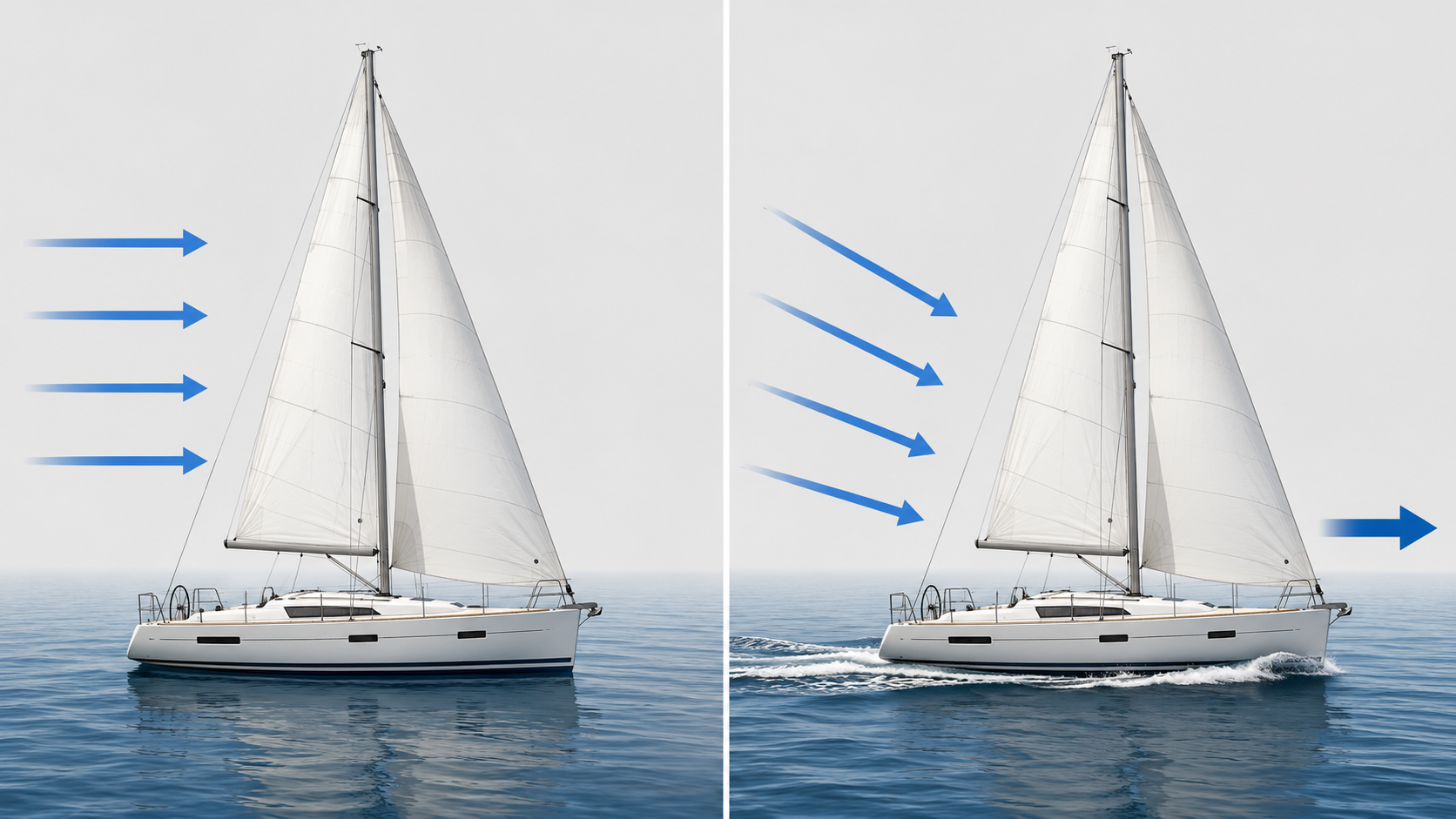
Therefore, the phrase "how a boat moves into the wind" always requires clarification. A sailboat cannot move directly into the wind: in this position, the forces do not provide longitudinal forward thrust. Movement occurs when the boat is heading at an angle, and its severity depends on the wind speed, the boat's speed, the characteristics of the vessel, the performance of the sails, and whether the angle is measured to the true wind or the apparent wind.
Why can't a boat sail straight against the wind?
A sail can be thought of as a flexible wing. A rigid wing has an airfoil and a chord, while a sail changes shape under the influence of the flow, so its efficiency differs from that of a rigid wing. But the general principle remains the same: to generate lift, an angle of attack—the angle between the sail's surface and the oncoming flow—is required.
Briefly, a sail's operation can be described through two related concepts. Airflow flows past it at different speeds, and the direction of air movement changes; this is due to the generation of lift. At the same time, the sail deflects the flow and, in return, receives a force in the opposite direction. The purpose of the telltale on the sail is precisely as a visual reference: it shows the direction of the airflow relative to the surface.
In the above-water part of the submarine there are two groups of forces:
- sail lift - it is directed perpendicular to the surface and, at the correct angle of attack, can create thrust;
- sail and hull drag - it is directed along the flow and interferes with movement.
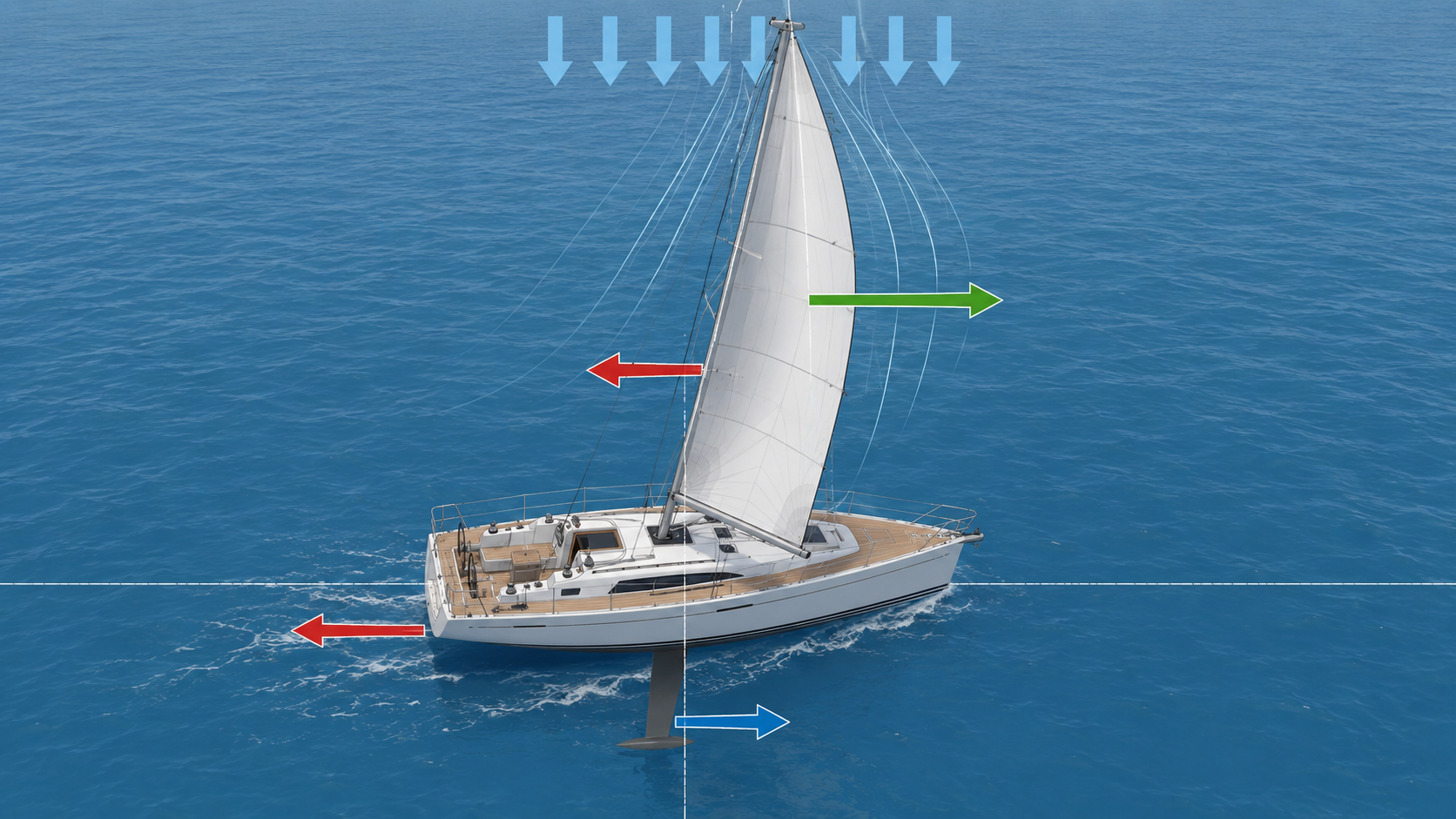
If an ideal profile is positioned directly into the wind, the lift force will be directed sideways. The drag of the sail and hull will then be directed rearward. Decomposing the resultant force along the boat's longitudinal and transverse axes, we obtain a lateral force and a negative longitudinal component: the boat receives no forward motion and may begin to back away.
The lateral component can be partially compensated for by a keel. It acts like a hydrofoil and reduces drift, but it doesn't make straight-ahead sailing possible: there's no way to generate longitudinal thrust. To move forward, you need to change the boat's position relative to the flow and create a longitudinal component of lift.
What happens to heading, roll, and forces when moving at an angle
When the boat is turned so the wind is coming at an angle, the sail takes on a different position relative to the flow. Lift still acts across the flow, and drag acts in its direction. Now their net effect may not be directed backward, but almost entirely sideways.
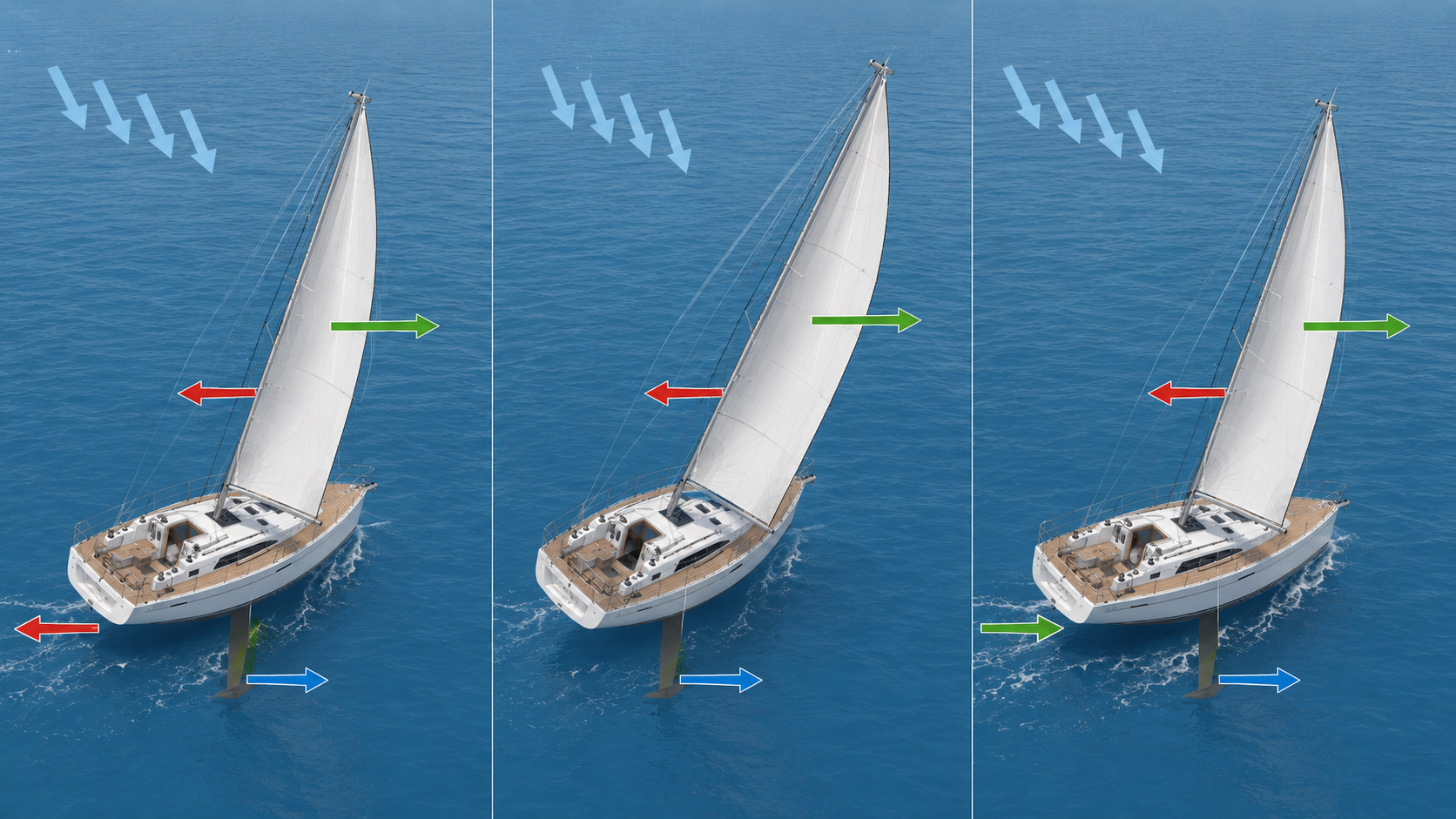
At this rate, the boat stops backing up, but that doesn't mean it's moving steadily forward. The longitudinal velocity becomes zero: the negative component has disappeared, but there's still no positive thrust. This is the borderline between backward and forward motion.
This is where maximum heeling can occur. Lift and drag combine to exert the strongest lateral force on the boat, while longitudinal movement is absent. Therefore, a high heel position doesn't necessarily mean fast sailing: the boat may move almost no forward or backward motion, yet the lateral force component will be at its maximum.
Then, two observable changes are possible. If the boat heads even closer to the wind, the sails begin to flap, and the heel decreases. If the boat gains forward momentum, the resulting weight shifts longitudinally, its transverse projection becomes smaller, and the heel also decreases. On board, it's useful to distinguish between these states: the boat is backing up, has stopped along its longitudinal axis, or has already gained forward momentum.
What determines the minimum angle of approach to the wind?
The minimum wind angle is not a constant property of a boat. It depends not only on the hull shape, keel, and sails, but also on the speed of the oncoming wind, the speed of the boat itself, and the sail trim.
As the wind speed increases, lift increases faster than drag. Therefore, in stronger winds, a boat can, under certain conditions, sail at a sharper angle. In some cases, an angle of around 29 degrees is reported, but this isn't universal: such an example comes with the caveat that the speed may not be high.
There's also a practical reason why advertised figures shouldn't be interpreted as a permanent result. It's logical to indicate the minimum wind angle at a wind speed where the boat is still sailing under full sail, but any further increase necessitates reefing. Changing the sail setting also changes the conditions under which performance is assessed.
The example polar diagram uses a wind speed of 20 knots. This means the figure refers to a given wind condition and does not describe the boat's performance in any wind. Such figures can only be compared when at least the basic conditions are the same: wind speed, boat speed, and sail condition.
This explains the everyday example of a charter. A promise that a boat will sail at a 35-degree angle may apply to one set of conditions, whereas in a light wind of around 7 knots, the actual course will be approximately 60 degrees. Before comparing boats, one should ask not only "What is the minimum angle?" but also "In what wind, in what conditions, and relative to what was it measured?"
How to distinguish true wind from apparent wind
True wind is the current of relatively still water. When a boat is stationary, this is what it feels. But when moving, an additional current appears, directed against the current, so the wind on board changes direction and becomes stronger.
This flow perceived by a moving boat is called by the pennant windIt's measured by an anemometer at the masthead: the instrument shows the wind felt by the boat itself while moving. Even with zero true wind, a boat moving forward will feel a flow opposite its course.
Therefore, the apparent wind angle cannot be automatically taken as the full angle between the course and the true wind. A keel reduces drift, but does not eliminate the difference between the two reference frames. When someone states a heading angle, it is first necessary to clarify which wind they are referring to, what the boat's speed is, and what the instrument is actually showing.
Why is twist needed and how is it changed on a mainsail?
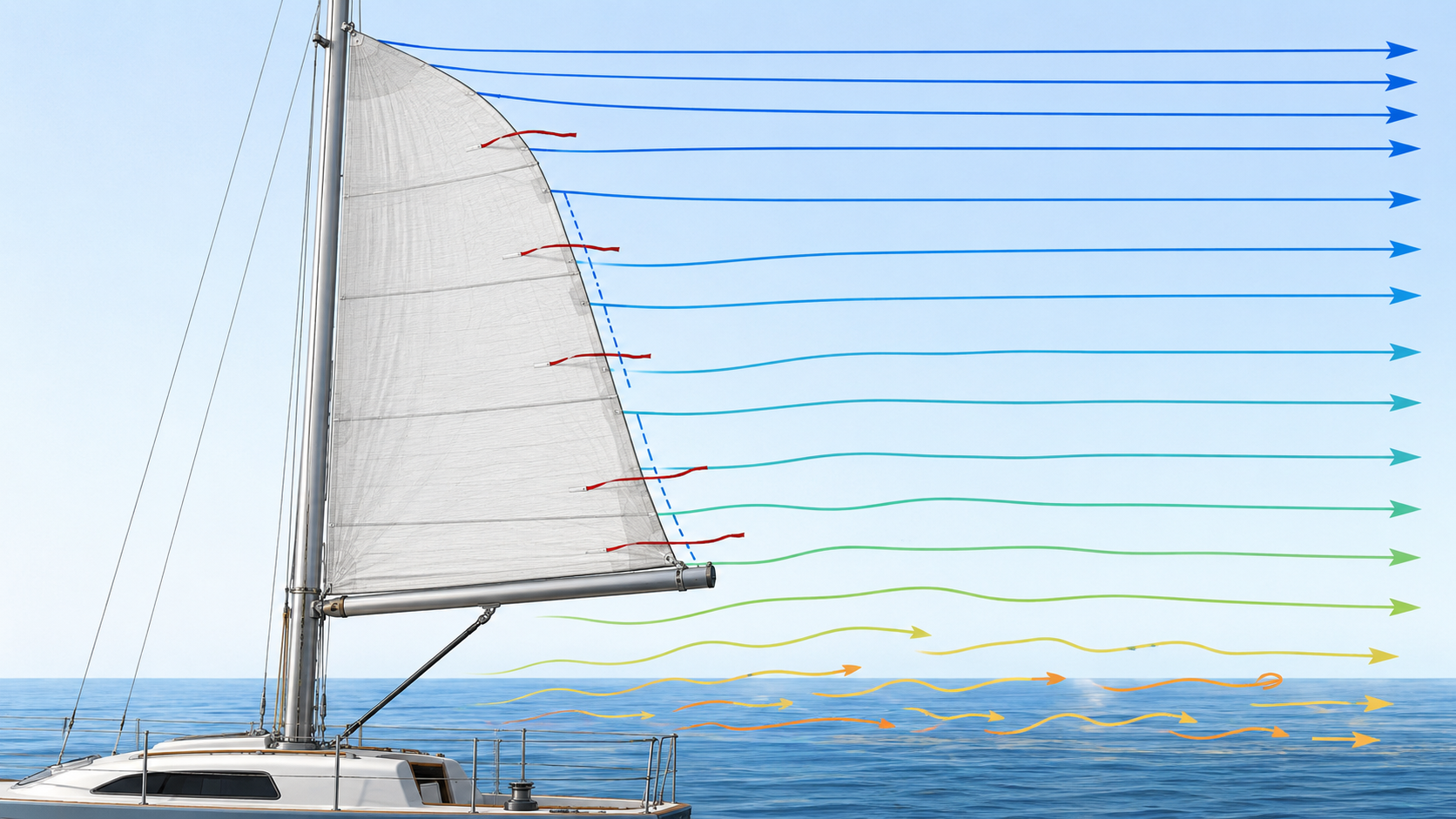
The wind isn't uniform across the entire sail height. Near the surface, the flow slows more, and higher up, its speed increases. The true wind direction may remain the same, but due to the varying flow speeds, the apparent wind at the bottom, middle, and top of the mast will have different angles.
If a boat had a rigid wing adjusted to the center of the mast, its angle to the airflow would be different at the top and bottom. A sail can compensate for this difference by changing its shape along its height. This gradual turn of the sail is called twistIt is always needed, and its value depends on how noticeable the wind gradient is.
For the mainsail in the described scheme, the twist is changed by changing the boom position. The sequence is as follows:
- Raise the boom up so that the mainsail changes shape and turns in the desired direction.
- To do this, you can release the boom guy or use the sheet - the specific option depends on the design of the rigging on the boat.
- Check whether the boom has moved to the side at the same time: its horizontal position must be maintained.
- If necessary, return the boom to the desired location using the boom sheet or two sheets, if such a system is provided on the boat.
Twist is always needed, but its amount and adjustment method depend on the height difference in flow and the boat's design. A specific combination of sheet, outrigger, and chase is not suitable for all yachts.
What to check when assessing a boat's performance to the wind
A sailboat can't sail directly into the wind: in this position, lift is directed transversely, and drag produces backward motion. Forward motion occurs at an angle, but its severity varies with the wind, boat speed, sail trim, and reference frame.
Before comparing boats or evaluating your own course, check four points:
- the boat is actually moving forward or has only just stopped moving backwards;
- the angle is indicated to the true or apparent wind;
- at what wind speed and boat speed was the indicator obtained;
- How the sails are set up and whether the height twist is taken into account.
Then the phrase “how a boat moves toward the wind” ceases to be a dispute over a single number: it becomes clear what forces create movement and what conditions lie behind the stated angle.