A yacht is preparing to enter a foreign port, and there are weapons on board. The captain must decide what to declare, where the weapons will be transferred after clearance, and whether the crew will be able to continue their voyage without legal issues. In one jurisdiction, they may seal them and take them into custody, in another, they may leave them on board, and in another, they may enter with the weapons.
The question of whether weapons can be carried on a yacht cannot be determined solely by the purchase documents. There is no universal rule: before each international voyage, it is necessary to check the country's requirements, the declaration procedure, and the safety of the yacht's route. Furthermore, weapons do not guarantee protection from an organized armed group, while concealed transportation can lead to inspection, detention, and serious legal consequences.
What happens to weapons when entering foreign waters?
The legality of weapons on a yacht is determined not only by how they were acquired. When clearing a yacht, customs officials are primarily interested in the mere presence of a weapon on board. Purchase documents can serve as additional proof, but they are no substitute for verifying the regulations of a particular jurisdiction.
Before entering, the order of actions looks like this:
- Learn the customs and entry regulations of the country or territory.
- Check if entry with weapons on board is permitted.
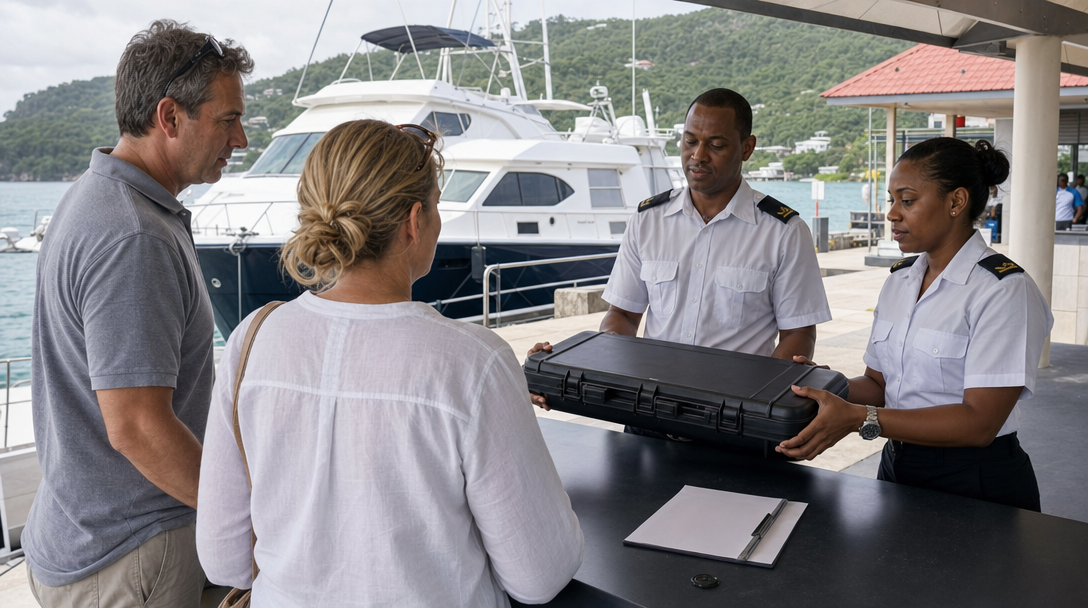
- When registering, please indicate the presence of weapons in the customs declaration.
- Find out whether it will be left on the yacht, accepted for storage, or whether import will be completely prohibited.
In the described case, the weapons were declared upon entry to Martinique. Police or customs officials then arrived at the yacht, drew up a transfer-under-supervision document, sealed the weapons, and took them into custody. The crew was allowed to remain in the waters, but they were no longer allowed to use the weapons or transport them between islands.
A similar scenario exists in French Polynesia: after crossing to another island, weapons would have to be returned to the initial clearance point before leaving the territory. This is only an example of a specific experience, not a universal rule for all French territories. In other waters, weapons may be left on board, while in Fiji, entry with any weapons is prohibited.
Why Hidden Cargo Doesn't Make a Yacht Safer
Concealed weapons transport on a yacht while crossing the border seems like a way to avoid formalities, but you can't count on a hidden stash. Inspections can be random or based on specific route information. Yachts are especially thoroughly inspected on routes associated with drug trafficking.
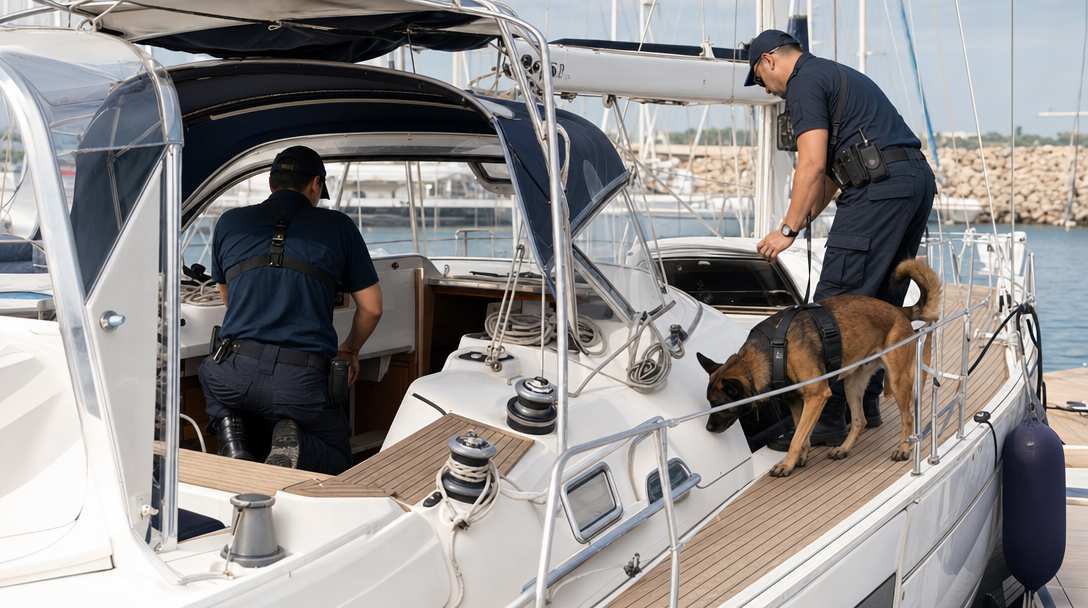
During inspections, they may search for narcotics, weapons, gunpowder, and explosives. In the cases described, dogs were used, and the interior search was very detailed:
- inspection of residential and technical premises;
- search for weapons and ammunition;
- use of service dogs;
- inspection of hidden spaces with technical means.
In some cases in Tahiti, people's yachts were searched, and the boat of their acquaintances was checked even more thoroughly: inspectors used cameras to examine the space between the furniture and the hull. This doesn't mean every crew on such a route will face a similar procedure. But this case illustrates why it's risky to base a crossing plan on the hope that weapons won't be discovered.
When an undeclared weapon is discovered, the problem isn't just the weapon itself. Search, detention, confiscation of the yacht, and criminal prosecution are possible—the specific procedures vary by jurisdiction. Therefore, the question of whether a weapon on a yacht needs to be declared should be decided before departure, not after inspectors have found it on board.
Does a gun help in an attack on a yacht?
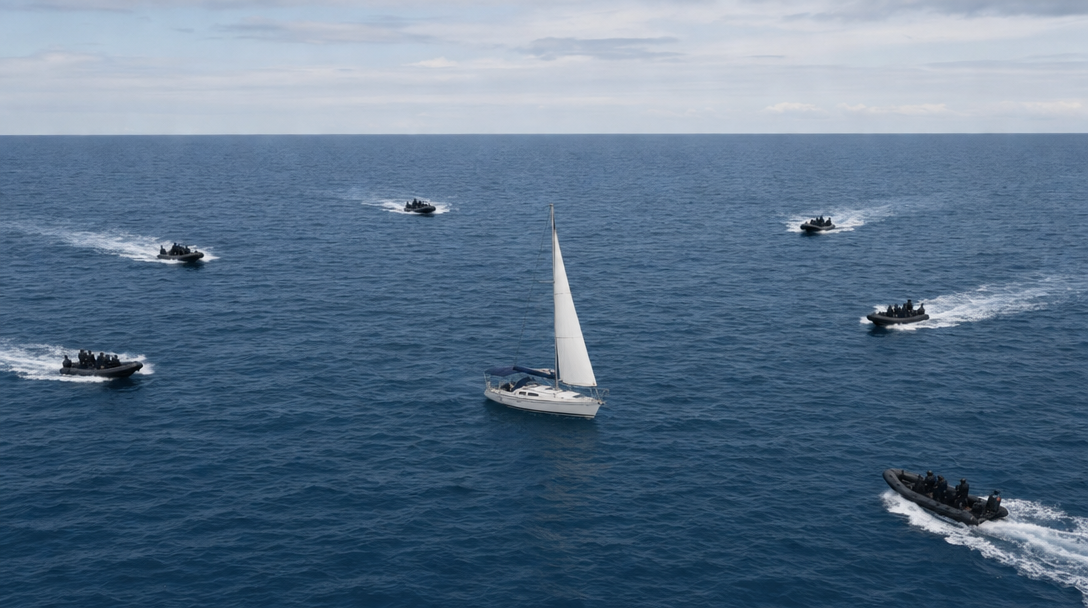
The desire to carry a weapon on board a yacht is usually linked to a specific threat: an attack while underway or at anchor. This is especially true for certain areas of Venezuela, Central America, and the route between the Philippines, Malaysia, and Indonesia. However, such incidents need to be assessed based on the specific route and time, rather than turning an isolated incident into a universal hazard map.
In the area between the Philippines, Malaysia, and Indonesia, a German yacht was attacked while traveling a similar route. The author's crew had previously passed through this region without incident, with warships stationed nearby and the crews maintaining radio contact. Two weeks later, a German couple, taking a similar but somewhat more distant route, was attacked. This account relates to a specific situation and does not allow for a prediction of the outcome of each passage.
Another incident occurred off the coast of Venezuela in December 2018. A speedboat carrying armed men approached the yacht, firing into the air. The crew continued to move away from the shore, and the Orion flare gun, according to the author, had a primarily psychological effect: the attackers changed course, continued to pose a threat, and then turned around. The distance from the shore, the yacht's movement, and the pursuers' limited fuel also played a role.
This incident cannot be used as a guide to using a flare gun or as proof of the weapon's effectiveness. The signal device may have influenced the attackers' behavior, but a repeat of this effect is not guaranteed. In an organized attack, the balance of power can be completely different: the group may have superior numbers, speed, and firepower.
Before deciding to transport weapons, you need to separately evaluate:
- what kind of threats are expected along the route;
- how many people and boats can participate in the attack;
- Do the attackers have an advantage in speed and weapons?
- Can weapons really make a difference, rather than just create additional legal risks?
If an organized group is attacking a yacht, the crew's personal weapons may not be enough to offset the difference in force. Therefore, yacht safety is not limited to weapons: sometimes it's wiser to reconsider a route than to rely on a weapon that doesn't provide a guaranteed advantage.
How to check the safety of a route before leaving
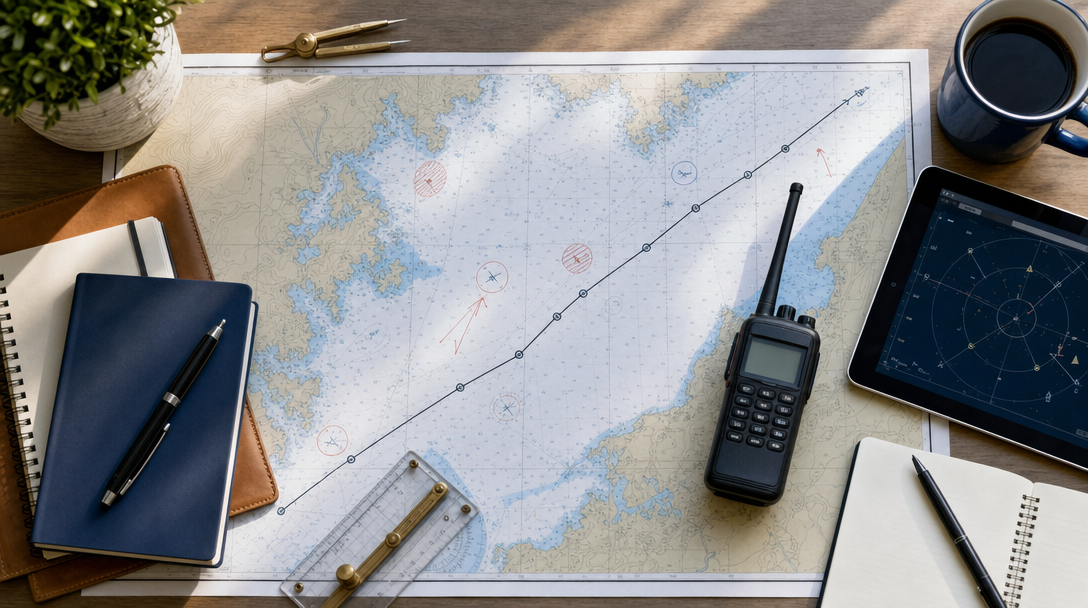
Preparation begins not with choosing a weapon, but with inspecting the specific water area. It's recommended to compare official information, recent incident reports, and reports from yachtsmen on the scene. This way, you can see not only individual incidents but also trends: whether incidents are becoming more frequent or, conversely, less frequent.
To assess the safety of a yacht's route, several sequential steps can be taken:
- Check the official Security section. Check your country or region's website for incident reports and safety regulations.
- View recent cases and their dynamics. It is important to assess the current situation and not rely only on old stories.
- Ask local yachtsmen. In thematic groups, you can find out what's happening at a specific marina, its moorings, and its passages. This is what local knowledge is—the knowledge accumulated by people who regularly navigate the region.
- Determine precautions in advance. In one place, locals advise not to leave the yacht unattended, in another - to remove the dinghy from the water at night or close it.
- Check available communication and monitoring channels. For the Red Sea and Gulf of Aden, the Atalanta Red Sea service is recommended, through which the crew transmitted coordinates and maintained contact with patrol forces.
- Match the risk with the route. If the situation is in doubt and the measures do not eliminate the imbalance of power, a change of route should be considered.
Red Sea's experience with Atalanta includes constant exchange of coordinates and radio communications with patrol forces, but notes that it doesn't know how the service would respond during an attack. Therefore, registration in such a system doesn't guarantee safety. It can be part of training, but it doesn't replace route assessment and communication with personnel on the ground.
Weapons on board a yacht: the decision starts with the route, not the weapons
Carrying a weapon on a yacht cannot be considered a universal means of protection. At each point during an international voyage, its legality, declaration, storage, and return procedures must be confirmed separately. The difference between legal registration and concealed transportation is fundamental: attempting to conceal a weapon increases the risk of inspection and legal consequences.
The potential usefulness of weapons is also limited. In a single incident, a flare gun could have a psychological effect, but against an organized and large group, the crew may find themselves at a distinct disadvantage. Therefore, it is considered wiser to avoid known dangerous areas and conduct preliminary assessments of the situation rather than relying on weapons for yacht security.
Before proceeding, please check:
- Is entry with weapons permitted in each country and territory of the route;
- Is it necessary to indicate it in the declaration and where will it be transferred after registration;
- whether the plan is based on covert transportation or the hope of avoiding inspection;
- whether the chosen route corresponds to the actual capabilities of the crew in the event of a threat.